 ™
™
Guides · 🏙️ City life
Lightning, Bells and a Bishop’s Gamble: The Full Story of Christ Church Cathedral
Christ Church Cathedral is the most audacious building project in pre-Confederation New Brunswick: begun in 1845 by a stubborn Tractarian bishop named John Medley, modelled on a medieval Norfolk church, and consecrated in 1853. It survived a catastrophic lightning strike in 1911 that melted its bells, carries a clock from the same London workshop that built Big Ben, and today faces a repair bill projected at $23.5 million. Here is the whole story, myths corrected, plus exactly how to see it for free.
Why a wooden colonial town got a stone cathedral
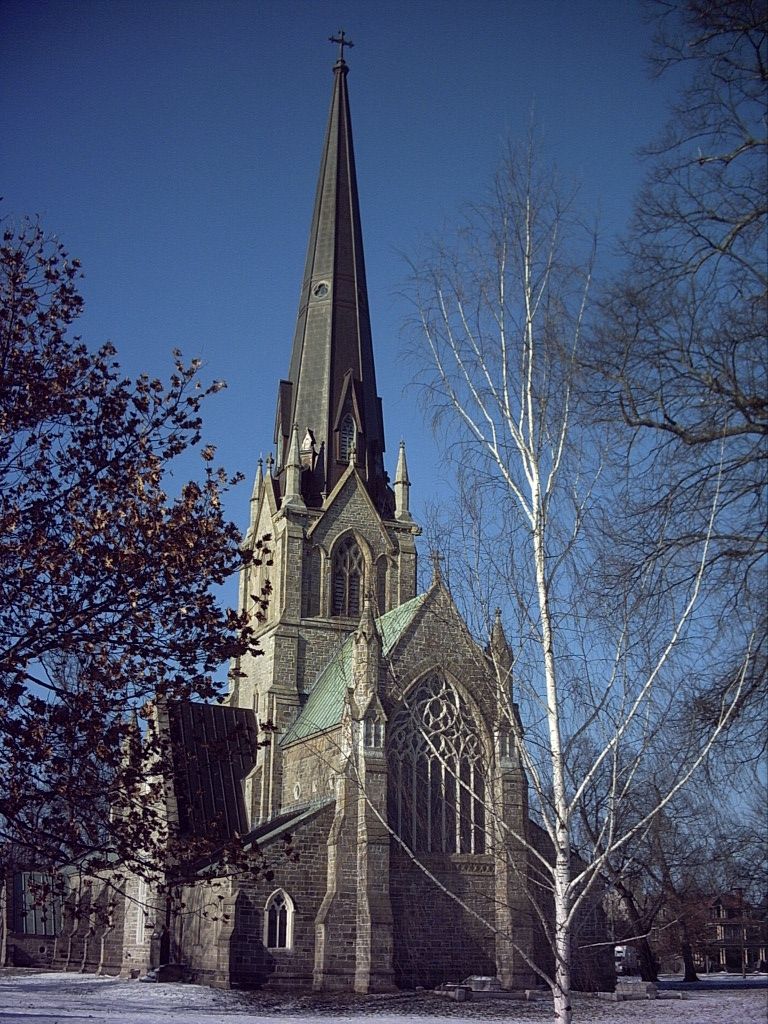
Stand at the corner of Church and Brunswick streets and look up. A 198-foot spire rises off a broad green beside the river, out of all proportion to the modest wooden capital that surrounded it when the first stone was laid. That mismatch is the whole point. In 1845 Fredericton had muddy streets, a garrison, a legislature and a few thousand souls. What it got anyway was a full Gothic cathedral, built to medieval principles, on the scale of an English market town’s proudest church. The official federal heritage record calls it “one of the best examples of ecclesiological Gothic Revival architecture in Canada,” and the Fredericton Heritage Trust goes further, calling it the most important Gothic Revival building in North America.
The claim is not local boosterism. Christ Church Cathedral was the first building in Canada, and among the first anywhere outside Britain, to follow closely the ideals of the Ecclesiological Society, the ferociously opinionated Cambridge movement that insisted churches be built the way the Middle Ages built them: honest stone, steep roofs, a deep chancel, every part of the building legible from outside. Once Fredericton proved it could be done in the colonies, the model rippled outward. Parks Canada credits this one building with establishing the pattern for Canadian church design for the rest of the nineteenth century.
One correction right at the top, because it sets the tone for this whole piece. Nearly every popular account, including the cathedral’s own materials, says it was declared a National Historic Site in 1983. The Parks Canada Directory of Federal Heritage Designations and the Canadian Register of Historic Places, the official records, both give the formal recognition date as 15 January 1981. When the popular version and the paperwork disagree, we go with the paperwork, and you will see us do that more than once below.
The bishop who arrived with a cathedral in his head
John Medley was born in London on 19 December 1804 and made his career in Devon: vicar of St. Thomas the Apostle near Exeter from 1838, then prebendary of Exeter Cathedral from 1842. He was, by the Dictionary of Canadian Biography’s account, small of stature, strong-minded and strong-willed. He was also something new: the first Tractarian to be made a bishop in the Church of England. The Oxford Movement men, John Keble among his acquaintances, believed worship should be beautiful, sacramental and rooted in the medieval church, and Medley had literally written the book on what that meant for buildings, publishing Elementary Remarks on Church Architecture in 1841.
The Colonial Bishoprics Fund voted £20,000 to endow the new see of Fredericton. Medley was appointed by letters patent on 25 April 1845, consecrated first Bishop of Fredericton at Lambeth Palace on 4 May 1845 by Archbishop Howley himself, and was enthroned in his new see city that June. He did not waste a season. He landed with a gift of £1,500 from the Exeter Diocesan Architectural Society already in hand for a cathedral, local subscriptions added thousands of pounds more, and the cornerstone went down that October, barely four months after his arrival. When the money later ran thin, he raised more at home and abroad, including begging voyages back to England.
Two things about Medley’s vision mattered as much as the architecture. First, he insisted the cathedral be free: no rented pews, no reserved seats for the gentry, because, in his words at the foundation ceremony, “none should be excluded for want of money.” He held that line his whole episcopate, even refusing to consecrate churches that clung to pew rents. In 1845 that was a quietly radical position. Second, he understood he was building an argument in stone, proof that the young colonial church could do what the mother church did, and do it properly. He would spend the next eight years making that argument pay for itself.
A Norfolk parish church, translated across an ocean
The cathedral’s DNA is English and traceable to one specific building: St. Mary’s Church at Snettisham in Norfolk, a fourteenth-century church Medley knew and admired. The detailed drawings of Snettisham were made before either man left England by Frank Wills, born in Exeter in December 1822, trained under John Hayward, an exhibitor at the Royal Academy by age nineteen, and a product of the same Exeter architectural circle as Medley himself. Wills crossed to New Brunswick in 1845, in his early twenties, to build a cathedral. Imagine being handed that commission before your twenty-third birthday.
The translation was not literal. Snettisham has a famous spire and a lost chancel; Fredericton would have both, arranged in a cruciform plan with a central tower. Early schemes called for twin western towers, quietly abandoned when costs climbed. And the design got international peer review of the most bruising kind: The Ecclesiologist, the movement’s journal, complained that the choir roof sat lower than the nave’s, which it judged unworthy of a cathedral. On the Ecclesiological Society’s recommendation, the great English architect William Butterfield, later famous for Keble College, Oxford, was brought in. Butterfield redesigned the choir and tower, reworked the east end, and designed the interior furnishings, which is why the official heritage record credits the building jointly to Wills and Butterfield. Medley, never shy, modified Butterfield’s drawings himself, and by one account personally designed the spire.
Wills, meanwhile, parlayed Fredericton into a continental career. He set up in New York by 1848, became official architect to the New York Ecclesiological Society, published Ancient Ecclesiastical Architecture and Its Principles in 1850, and won the commission for Christ Church Cathedral in Montreal. He died in Montreal on 22 April 1857, aged just thirty-four, having changed North American church architecture twice before most architects finish their first decade. His other Fredericton building, the tiny and perfect St. Anne’s Chapel, begun in May 1846 and consecrated in March 1847, was the trial run for the whole revolution.
Eight years of stone, mud and money trouble
The foundation ceremony on 15 October 1845 was the biggest public event Fredericton had ever staged. Lieutenant-Governor Sir William Colebrooke laid the granite cornerstone with a silver trowel, the gift of a Mr. Spahn of Fredericton, presented to him by the bishop for the occasion. Around them stood the archdeacon, the bishop’s chaplain, nineteen more robed clergy, judges, officers of the garrison, members of the legislature, and a crowd the contemporary account put at two to three thousand. Colebrooke spoke of Gothic spires inspiring “lofty and sublime emotions.” Medley spoke of a church open to everyone.
Sealed inside that cornerstone is a bottle containing coins of the realm and a parchment inscribed in Latin, deposited in a cavity of the great granite block, still waiting there nearly 180 years later.
Then came the hard part. The nave and aisle walls were up by the end of 1847, at which point the money essentially ran out, hence the fundraising in England. The choir and tower were finished in 1849, the design was proudly published in the Illustrated London News that same year, and the spire rose in 1851. But nervousness about whether the foundations could carry the full design meant that spire, a wooden broach spire clad in zinc, was deliberately built 26 feet shorter than the 198 feet on the drawings. Hold that thought; the sky itself would eventually fix it. The walls drew on sandstone barged from Grindstone Island on New Brunswick’s Fundy shore, with creamy Caen stone imported from Normandy for the window tracery, all of it wrapped around an interior of piers, side aisles and exposed timber trusses.
The glass came early and came fine. Most windows were installed between 1850 and 1852: the great east window by William Wailes of Newcastle, its tracery patterned on Selby Abbey and its cost shared by Wailes himself and Trinity Episcopal Church in New York; the west window by William Warrington, a near likeness of Snettisham’s own; aisle windows from the Beer studio of Exeter; clerestory glass copied from Exeter Cathedral. On 31 August 1853, with bishops from across British North America in attendance, the 172-foot-long cathedral was consecrated. Total elapsed time: eight years, in a colony with no tradition of stone church building at this scale.
Getting the famous “first since the Conquest” claim right
You will hear it on every tour, and it appeared in print the very week the cornerstone was laid: this was, in the contemporary account’s words, “the first which has been begun since the Norman Conquest, that is, for the last 700 years.” The cathedral itself has republished that 1845 boast. Is it true? Mostly, with asterisks worth knowing, because the loose version gets repeated in ways a careful historian can pick apart.
The asterisks: Salisbury Cathedral was begun on a fresh site in 1220, well after the Conquest, but that was an old see relocating from Old Sarum, not a new one being founded. Wren’s St. Paul’s rose from scratch after 1666, but on the ancient foundation of an existing diocese. And the new English dioceses of Medley’s own lifetime, Ripon in 1836 and Manchester in 1847, simply promoted existing minster churches to cathedral rank rather than building anything.
So the defensible, precise version is this: Christ Church was the first entirely new Anglican cathedral, begun from the ground up for a newly created see, since the Middle Ages. No existing church upgraded, no old foundation reused, no relocated diocese: a new bishop, a new see created by royal letters patent, and a new cathedral rising together out of a riverside field. That combination genuinely had no precedent in the Church of England for roughly seven centuries, and it is why architectural historians treat this building, not any church in England, as the proving ground of the Gothic Revival’s cathedral ambitions. Say it that way and you can defend it against any pedant in the room. A related bit of local lore, that Fredericton owes its status as a “city” to the cathedral under the old English custom that a cathedral town is a city, is part of the civic mythology too, and the timing fits: the see arrived in 1845, and city incorporation followed in 1848.
The night the sky took the spire
On 3 July 1911, lightning struck the cathedral and the resulting fire did what fires in wooden-spired Gothic buildings do. The spire was completely destroyed and the choir gutted. The eight bells in the tower melted in the heat. Butterfield’s original furnishings and the organ were lost. Accounts describe molten metal and burning timber coming down inside the tower, one of the most dramatic single nights in Fredericton’s history. It is a small miracle of that night that the 1853 Dent clock mechanism, sitting in the very tower where the bells were liquefying, survived and still runs today.
The rebuild took just over a year and cost about $100,000, an enormous sum for a small diocese in 1911. Here the record forks, and we will flag it honestly: the official federal heritage documentation credits the 1911 to 1913 restoration to J. deLancey Robinson of New York, while the Fredericton Heritage Trust and other local accounts credit Cass Gilbert, the American celebrity architect then designing New York’s Woolworth Building, with administering the reconstruction. Both names belong in the story; the designation record puts Robinson’s first.
The disaster came with two silver linings. First, the spire was rebuilt to the full 198 feet the original designers had wanted in 1851 but had not dared to build, with the foundations reinforced to carry it, so today’s skyline is actually closer to the Victorian dream than the Victorian reality was. Second, the bells were replaced and then some: New Brunswick-born financier James Dunn, later Sir James Dunn of Algoma Steel fame and one of the province’s great expatriate characters, replaced the melted eight and added seven more, giving the tower fifteen bells by the re-dedication in August 1912. A new organ with 2,671 pipes went into the north transept the same year; its four-manual Casavant Frères console, Opus 2399, dates from 1957. The cathedral marked its 150th anniversary of consecration on 31 August 2003, scars long since healed.
The clock that isn’t Big Ben, and the bells that never swing
Now for Fredericton’s favourite piece of cathedral lore, which needs both celebrating and correcting. The tower clock was built in 1853 by Dent of London and installed in 1854. Local tradition, tourism copy and even some published accounts call it a “working model” or “exact copy” of Big Ben. Here is the problem with “copy”: the Great Clock of Westminster was not finished until 1854 and did not start ticking in its tower until 1859. A clock built in 1853 cannot copy one that did not yet exist.
What is true is arguably better. Dent was precisely the firm then building the Westminster clock, with founder Edward John Dent dying in 1853 in the middle of that famous commission. Fredericton’s clock came out of the same workshop, in the same years, from the same horological bloodline. Call it Big Ben’s elder cousin, or a sibling born first, and you are on solid ground. The machinery is gloriously physical: a four-foot dial, a movement reached by a narrow spiral staircase of 51 steps, and two drive weights of roughly 454 and 136 kilograms that three people still wind by hand every month.
The clock still chimes the Westminster quarters, but the big hour strike has been silent since 2007, stopped after noise complaints from neighbours. In a city that spent a century setting its watches by the cathedral, that decision still rankles some old-timers.
The bells are their own oddity. Dunn’s fifteen bells do not swing. They hang stationary and are struck by hammers driven by compressed air, played from a mechanism rather than hauled on ropes by a sweating band of ringers. As of a 2019 count, only four other Canadian churches used the same system. When the bells ring across the river on a Sunday, you are hearing one of the rarest musical instruments in the country.
The humans in the stone
Medley outlasted nearly everyone who doubted him. He served forty-seven years as bishop, became Metropolitan of Canada in 1879, and died in Fredericton on 9 September 1892. His burial arrangements are one of the cathedral’s most moving details, and one visitors routinely get wrong: the bishop himself lies outside, buried beneath the great east window of the church he built, in the ground, in the weather. Inside, a memorial altar tomb carries his marble effigy, recumbent in the medieval manner, so there are in effect two Medley tombs, and only one contains Medley. His second wife, Margaret Hudson of Exeter, whom he married on Campobello Island in June 1863, outlived him by thirteen years and was so loved in Fredericton that St. Margaret’s Church is said to be named in her honour.
The women’s story continues in the Mothers’ Union, the worldwide Anglican movement founded by Mary Sumner in England in 1876. Some local retellings inflate Fredericton’s role here, so, precisely: the Canadian Mothers’ Union dates from 1888, when Harriet Ann Boomer founded its first branch at Bishop Cronyn Memorial Church in London, Ontario. The cathedral hosts an active branch today, part of an unbroken tradition of women’s ministry in a building whose founding bishop insisted the doors be open to all.
The craft is everywhere once you slow down. Butterfield’s original furnishings burned in 1911, but the rebuilt chancel was refitted with carved oak stalls in the full English quire tradition, the vocabulary of canopies, poppyheads and misericord-style carving that Wills and Butterfield knew by heart. Flanking the west window are two windows from 1879, the only ones in the building made with gold dust in the glass; the final window arrived in 1908 in the choir vestry, completing a glazing program nearly sixty years long. And the institution itself is a curiosity: Christ Church is the only cathedral in Canada that is not also a parish, governed on the old English model by its Bishop and Chapter, a direct administrative echo of Medley’s determination to build a real cathedral foundation, not just a big parish church with a fancy title.
Near-death moments and the price of survival
A stone building in a freeze-thaw climate is never finished, and the cathedral’s modern history is a cycle of rescue. The big one came in the 1990s: a restoration program costing about $2.5 million that refaced stonework, repointed the Caen stone tracery, cleaned and refinished the woodwork, and strengthened the masonry, capped in 1995 when the spire was sheathed in new copper and crowned with a new cross. Anyone who photographed the cathedral in the early 1990s versus 2000 saw the difference. Then, on 6 August 2006, fire returned, this time inside the bell tower. Sprinklers caught the blaze, but the water damage closed the building for months of repairs, a sharp reminder of 1911 for a congregation that needed none.
The current chapter is the most expensive yet, and it has moved fast, so here is the verified state of play. A 2018 to 2019 survey pegged full repairs at about $10 million. The cathedral commissioned Heritage Standing Inc., the Fredericton conservation engineering firm, to produce a full conservation master plan guided by the national Standards and Guidelines for historic places; the plan won a 2023 Award of Excellence from the Canadian Association of Heritage Professionals. In May 2024, after public speculation, the Anglican diocese announced it would not sell the building, with repairs then estimated around $17 million. By January 2026 the projection had climbed to $23.5 million in 2030 dollars, a figure that includes tax, engineering oversight and a $6 million maintenance endowment, and that Archbishop David Edwards admitted had shocked diocesan leaders.
The decisive moment came at a special synod on 18 April 2026, where, as CTV reported, more than 200 Anglican representatives from across New Brunswick gathered. Delegates advised the archbishop to pursue transferring the cathedral to an independent charitable foundation, with the diocese keeping worship rights and church officers sitting on the board beside civic representatives, a structure that unlocks government heritage funding churches cannot normally touch. There is an honest exit clause: if the fundraising fails, the building would be offered first to the City of Fredericton, and only then to the open market. In other words, the cathedral has been spared, conditionally, and the strategy is the long game Medley himself would recognize: raise the money, phase the work, and keep arguing that this building is worth more than it costs. Every generation of Frederictonians since 1845 has ultimately agreed, and the smart money says this one will too.
Standing on the green today
The cathedral stands on a generous green near the river, and the green is half the experience. This is the river the Wolastoqiyik have known for millennia as the Wolastoq, the beautiful river, and the cathedral sits within their traditional territory, a few minutes’ walk from the heart of what was the settlement at St. Anne’s Point; our Wolastoqey Fredericton guide tells that much older story. The lawns, the surviving canopy of the city Fredericton’s boosters long called the city of stately elms, and the sightline from the riverfront trail make this one of the most photographed few acres in New Brunswick. Golden hour on the copper spire is the local photographer’s cheat code.
Visiting is easy and free. The cathedral sits at 168 Church Street at Brunswick, an easy walk from downtown, the Green and the museum district. In July and August, guided tours run Monday to Saturday from 9:00 a.m. to 5:00 p.m. and on Sundays after worship until 4:00 p.m., free of charge with donations welcomed, and self-guided booklets are available in English, French and German. Summer usually brings organ and choral music too. Outside tour season, the building is open around services and by arrangement through the office at 506-450-8500; current schedules live at cccath.ca.
Go on a weekday if you can, when you may have the nave to yourself. Find the Dent clock’s dial, stand under the crossing where molten bells once rained down, look for the gold-dust windows beside the west window in the low afternoon light, and pay your respects at both Medleys: the marble one indoors and the real one in the grass beneath the east window. Then walk the two blocks to the Old Burial Ground, whose stories, some of them decidedly spooky, we cover in Haunted Fredericton, and you will have traced the whole arc of Anglican Fredericton in an afternoon. More of the city’s built-heritage stories live in our heritage hub.
Key takeaways
- The cathedral’s clock was built by Dent of London in 1853, before Big Ben’s own movement was even finished, so it cannot be a copy of Big Ben; it is more accurately Big Ben’s elder cousin from the same workshop.
- Parks Canada’s official directory records the National Historic Site designation as 15 January 1981, even though nearly every popular account, including the cathedral’s own, says 1983.
- The fifteen bells never swing: they hang stationary and are struck by compressed-air hammers, a system shared with only four other Canadian churches as of 2019.
- Bishop Medley is actually buried outdoors beneath the east window; the marble effigy tomb inside the cathedral is a memorial and does not contain him.
- The 1851 spire was deliberately built 26 feet shorter than designed because of foundation worries, and only reached its intended 198 feet in the rebuild after the 1911 lightning fire.
- Local accounts credit Cass Gilbert, architect of New York’s Woolworth Building, with administering the 1911 to 1913 rebuild, though the official heritage record names J. deLancey Robinson of New York.
- At a special synod in April 2026, more than 200 Anglican representatives backed transferring the cathedral to a charitable foundation to fund repairs projected at $23.5 million in 2030 dollars.
Common questions
Is Christ Church Cathedral free to visit?
Why is Christ Church Cathedral historically significant?
Is the cathedral clock really a prototype of Big Ben?
What happened in the 1911 fire?
Is Christ Church Cathedral still an active church?
Who was Bishop John Medley?

Get the Hey Freddy week ahead, every Monday
Fredericton’s events for the week, in one short email. Free, unsubscribe anytime.
Sources & further reading
This guide reflects the documented local consensus, reporting, reviews and community voices, verified where possible. Things change; if we’re out of date, tell Freddy.
- Parks Canada Directory of Federal Heritage Designations: Christ Church Cathedral NHS
- Canadian Register of Historic Places: Christ Church Cathedral National Historic Site
- Christ Church Cathedral: Cathedral History
- Christ Church Cathedral: An Account of the Laying of the Foundation Stone
- Christ Church Cathedral: Cathedral Tours
- Dictionary of Canadian Biography: John Medley
- Anglican Diocese of Fredericton: John Medley (Citizens with the Saints)
- Anglican Diocese of Fredericton: Synod Commons Explores Cathedral’s Future
- Wikipedia: Christ Church Cathedral (Fredericton)
- Wikipedia: Frank Wills (architect)
- Fredericton Heritage Trust: Christ Church Cathedral
- Heritage Standing Inc.: Christ Church Cathedral conservation master plan
- CTV News: Historic cathedral in Fredericton faces repair bill over $23 million
- CBC News: Anglican diocese won’t sell historic Fredericton cathedral in dire need of costly repairs