 ™
™
Guides · 🏙️ City life
The Town the Boss Built: Inside the Marysville Historic District
Cross the Nashwaak into Marysville and you step into one of the most complete 19th-century company towns left in Canada. Lumber king Alexander “Boss” Gibson raised a 418-foot brick cotton mill here between 1883 and 1885, ringed it with brick rowhouses, a Gothic church and a school, and ran the whole place like a benevolent (and slightly terrifying) father. The mill closed for good in 1975, sat derelict for seven years, then became Marysville Place when the province restored it beginning in 1985. The mill was declared a National Historic Site in 1986, and the entire district followed in 1993. It is still, fiercely, its own town.
Why Marysville matters more than almost anywhere else in Fredericton
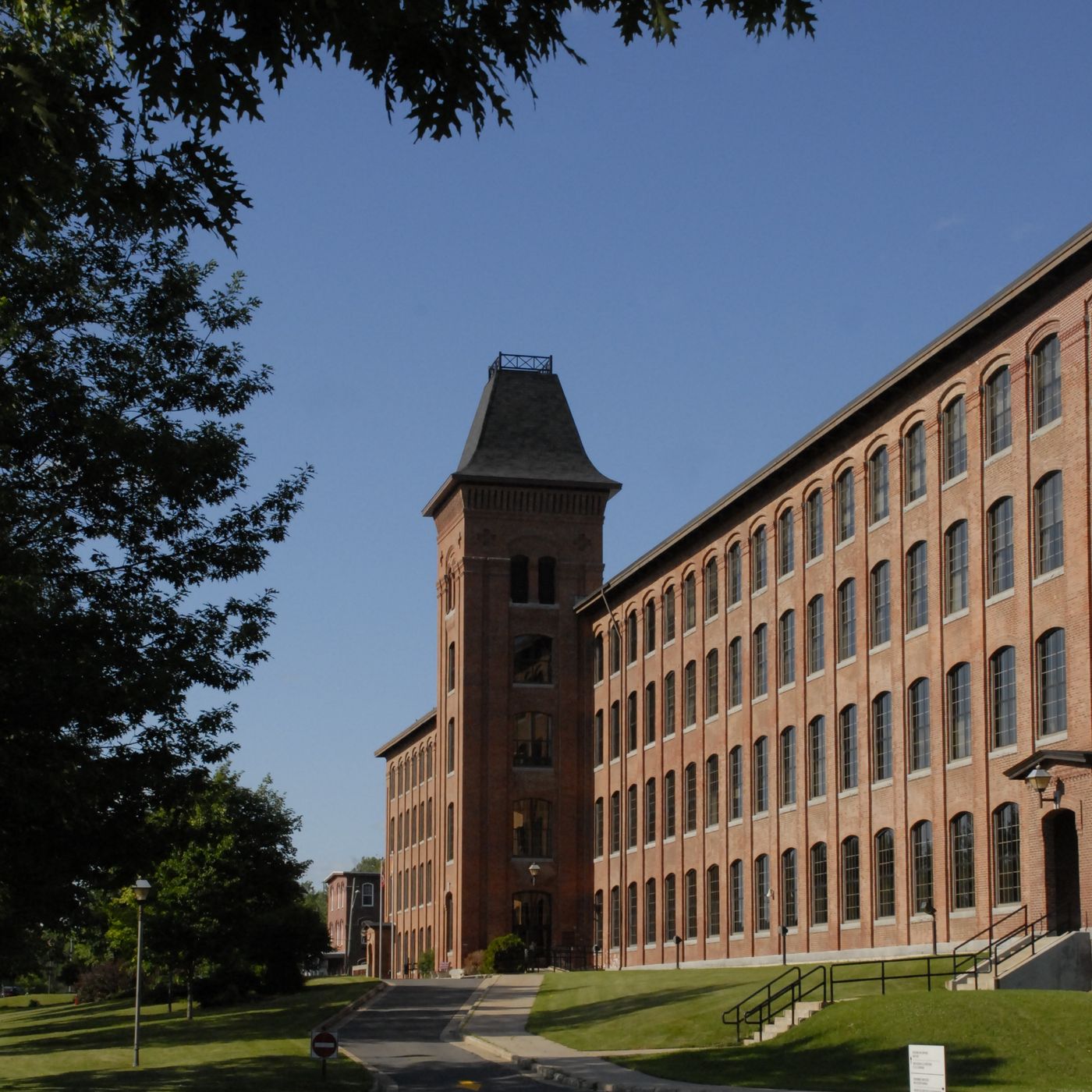
Every Canadian city has a heritage district. Almost none has what Fredericton has on the banks of the Nashwaak River: an entire 19th-century industrial universe, intact. The mill is still there, four storeys of red brick with its central tower reflected in the water. The workers’ houses are still there, row on row, people living in them, laundry on the lines. The managers’ houses still look down from their hill. The church the mill owner built still holds services. When the Marysville Historic District was designated a National Historic Site of Canada on November 20, 1993, the official records called it “a rare example of a single-industry company town of the 19th century possessing both its plant and company housing.” Strip out the careful federal language and the meaning is simple: everywhere else in Canada, towns like this were demolished, burned, or renovated beyond recognition. Marysville survived whole.
The numbers in the designation records are worth pausing on. The district takes in the great cotton mill, 39 brick duplexes, 14 single brick houses, a former three-storey boarding house, 11 wood-frame duplexes along River Street, 19 managers’ and merchants’ residences along Canada Street, and the old Gibson company store on Mill Street. That is not a preserved building or two. That is a complete social diagram of the industrial 19th century, rendered in brick and clapboard: managers on the hill, workers in the rows, single women in the boarding house, everyone within earshot of the mill bell.
Parks Canada reads the district as a physical record of the National Policy, the protective tariff era that conjured Canadian factories into being in the 1880s. Locals read it differently: as the personal kingdom of one enormous, red-bearded autocrat named Alexander Gibson, whom everyone then and now calls the Boss. Both readings are correct, and this guide will give you both. For where Marysville fits among the city’s other treasures, start with our museums and heritage guide, then come back. This one deserves the full telling.
Before the bricks: the Nashwaak before Gibson
The Nashwaak was a highway long before it was a millpond. The river valley sits inside the homeland of the Wolastoqiyik, and its name is generally taken to descend from a Wolastoqey word, worn smooth by two centuries of English and French tongues. The river mattered because of where it led: up the Nashwaak and over a height of land, travellers could portage through to the Miramichi watershed, a through-route between the Wolastoq and the Gulf of St. Lawrence that predates every road in New Brunswick. The French understood the river’s value too, planting Fort Nashwaak at its mouth in the 1690s and making it, for a few years, the capital of Acadia. For the deeper story of this territory, see our guide to Wolastoqey Fredericton.
There was also, the standard references record, a village here before Marysville: an Acadian settlement called Sainte-Marie, which stood near this stretch of the Nashwaak until it was burned in 1758 during the campaigns of the Expulsion. The coincidence of names (Sainte-Marie, then Marysville a century later, named for entirely different Marys) is one of those historical rhymes that no novelist would dare invent.
The English-speaking settlement that became Marysville began in the 1840s as a rough logging hamlet around water-powered sawmills, a place remembered as Rankin Mills, with a cluster of frame duplexes that would later be absorbed into Gibson’s plans. By the early 1860s the operation had passed through several owners and prospered under none of them. The place that greeted its next purchaser was, by the accounts that survive, grim: typhoid endemic, the buildings filthy, a contaminated well. What it had going for it was the river itself, a dependable head of water power, and behind it thousands of square kilometres of spruce. It was waiting for someone who believed the problem was management, not geography.
Alexander ‘Boss’ Gibson: mill boy, lumber king, railway baron
Alexander Gibson was born near St. Andrews, New Brunswick, most likely on August 1, 1819 (some sources say 1820; the Dictionary of Canadian Biography leans 1819, and he was buried as a man of 94). He grew up poor, went to work young, and learned the lumber business from the floor up in the Milltown mills on the St. Croix, where he mastered the new gang-saw technology of the 1840s and ran a mill of his own at Lepreau in the 1850s. He grew into a physically enormous man with a red beard and a gift for dominating a room without raising his voice.
In the autumn of 1862 he bought the failing Nashwaak operation for £7,300: sawmills and grist mills, water rights, houses, a farm, a store, and 7,000 acres of prime spruce land. The previous owners grumbled that they had invested nearly five times that sum. Within a year Gibson had paid off the £4,500 promissory note that financed the deal, and his mills were handling three fifths of an estimated 40 million board feet in that spring’s log drive. Over the following decades he assembled an empire that eventually ran to more than 180,000 acres of freehold timberland plus roughly 110,000 acres of crown licences. The typhoid problem he handled with characteristic subtlety: several of the worst houses were burned and the contaminated well filled in. With his chief carpenter Samuel Butler he then built a new village, the White Row of 24 tidy double tenements, along with a new school and a large new store. He named the place Marysville, for his wife and for his eldest daughter, both named Mary; the daughter, Mary Ann, died in 1867, and the name became a memorial.
Then came the railways, because of course they did. Gibson became president of the New Brunswick Railway in 1872 and drove the narrow-gauge line through to Edmundston by 1878 on the strength of a land grant of 1,647,772 acres. He sold out in 1880 to the syndicate around George Stephen for roughly two million dollars, pocketing about $800,000, an almost incomprehensible fortune in 1880s New Brunswick. He then built the Northern and Western Railway across to the Miramichi with Chatham’s Jabez Snowball; it was reorganized as the Canada Eastern in 1890. The two magnates quarrelled so bitterly that in 1893 Gibson boycotted the line entirely, reopening an old road and moving freight between Marysville and Fredericton by horse team until he had bought Snowball out. At his peak he employed as many as 2,000 people, worked 600 horses in the winter woods, and cut roughly a third of the entire province’s lumber output.
There was a darker hinge in the middle of all this. Between July 1880 and February 1881 Gibson lost his father, his eldest son John Thomas, and then two of John Thomas’s young children in quick succession. Grieving and adrift in his early sixties, he was advised by the Liberal leader Edward Blake to pour himself into the welfare of his people: “For as you minister to those people your burden will be lessened and gradually disappear, it was the Master’s way.” What Gibson built next was, in a real sense, his answer to that advice.
Raising the mill, 1883 to 1885
The cotton mill was the most audacious industrial project New Brunswick had ever seen. Gibson hired the great New England mill engineers Lockwood, Greene & Company to design it (Parks Canada’s designation records call them a Boston firm; the Dictionary of Canadian Biography places the firm’s man A. H. Kelsey in Providence, Rhode Island, and both are defensible, since the firm straddled New England). Either way, the pedigree matters: these were heirs of the Lowell and Rhode Island mill-building tradition, and Marysville was designed to the most advanced New England standard of the day, the brick pier “insurance mill,” engineered so a fire on one floor would not take the building.
The scale still startles. The main block runs 418 feet long by 100 feet wide, four storeys of brick beneath a five-storey central tower. Construction began in 1883 and finished in 1885, with the Saint John masonry firm of B. Mooney & Sons recorded as builder. Nearly everything except the southern hard pine posts and beams came off Gibson’s own lands: the clay was dug on site and fired in what the Dictionary of Canadian Biography describes as one of the largest brickyards in Canada, directed by expert workmen brought from Ontario, with the bricks laid under Captain Kelsey Mooney of Saint John. Popular tellings put the brick count in the millions, and while no two accounts agree on a number, the yard ran flat out for the better part of two years, so the millions are believable. The project was already a spectacle before it opened: the Fredericton Region Museum records a visit from the Governor General, Lord Lansdowne, to inspect Gibson’s works on October 23, 1884. The finished mill carried 800 electric lights, the first to be installed anywhere in the Fredericton area, plus steam heat and a sprinkler system, in 1885.
The machinery came up from New England, and the first raw cotton arrived at the end of April 1885. Around the mill Gibson filled the fields behind the White Row with brick double tenements marching up the hillside, and added a three-storey brick hotel to board the unmarried women who would make up so much of his workforce, a direct echo of the Lowell boarding-house system.
On Boxing Day 1885, to celebrate the mill’s completion, Gibson sat more than a thousand employees and their families down to dinner at once. The fare, in the Dictionary of Canadian Biography’s words, was “on a heroic scale”: one turkey for every four people, with vegetables, plum pudding, rich pastries, oranges, apples and grapes. In 1885 New Brunswick, most of those workers had never seen an orange in December.
Cotton town: life and labour under the Boss
By November 1889 roughly 500 people worked the spinning and weaving floors, and about two thirds of them were women, many of them young, many boarding at the hotel. Whole families ran on mill time: the bell, the long shifts, the company house, the company store. Like every Canadian cotton mill of the 1880s, Marysville ran on cheap labour, and youth was part of the bargain; children and young teenagers were a normal presence in the industry that the 1888 royal commission on the relations of labour and capital documented across the Maritimes. Later scholarship on Marysville is blunt about what the heritage plaques soften: low wages, hard conditions, and a firmly anti-union management culture that persisted long after Gibson himself was gone. A recent University of New Brunswick project, an audio walk built from the recorded voices of Marysville residents, exists precisely to put the workers’ side of the ledger back into the story.
And yet Gibson’s paternalism was real, and locals knew the difference between the Boss and an absentee shareholder. He paid the minister’s and organist’s salaries and slipped the choir an annual gratuity. The radical Fredericton editor Martin Butler, no friend of capital, wrote that there had never been a case of necessity or calamity brought to Gibson that he did not reach “down deep into his pockets to alleviate.” His son James built the town a covered skating rink, sponsored hockey and baseball teams, organized a brass band, bought Marysville a merry-go-round, and had nearly completed a racetrack.
The price of all this was control. Gibson prohibited the sale of alcohol in his town. He kept a close ear on the sermons in his own church and had a famous aversion to any mention of the fires of hell, presumably on the theory that his workers heard enough about heat on the mill floor. A millhand named Louis Joseph King summed up the arrangement with the best one-liner in Marysville history, calling Gibson “a kind of Protestant pope.”
The church itself was the town’s crown. Dedicated in January 1873, a full decade before the cotton mill, the Marysville Methodist Church rose in Gothic Revival splendour, its spire visible the length of the valley. A Toronto Globe correspondent called it “probably as fine a specimen of pure Gothic as can be found in America.” It survives today as Gibson Memorial United Church, still in use. (Visitors sometimes guess it must be dedicated to St. Mary, given the town’s name; it never was. Gibson was a Methodist to his boots, and the Marys were his wife and daughter.)
The fall of the Boss
The empire began leaking almost as soon as the mill opened. By 1886 Canada simply had too many cotton mills chasing too few customers, a hangover of the National Policy boom. Montreal interests formed a cartel to restrict production; Gibson refused to join, squeezing his St. Croix rivals hard, then joined in 1888, then watched the arrangement collapse. From 1894 his mill kept its own corporate skin but marketed its output through the Canadian Coloured Cotton Mills combine run by Montreal’s Andrew Gault and David Morrice. The Boss who answered to nobody now answered, at least commercially, to Montreal.
The deeper problem was structural. Gibson ran everything as what the Dictionary of Canadian Biography calls an “old-fashioned family concern dependent on the banks for working capital, with a patriarchal head who was contemptuous of banking rules.” By the late 1890s his timberlands were cut over and his sawmills aging, and his consolidated firm, the Alexander Gibson Railway and Manufacturing Company, was carrying a $2 million trust mortgage plus a $1.75 million second mortgage in 30-year bonds. In 1902 the Halifax financier John F. Stairs sent a sharp young agent named William Maxwell Aitken, the future Lord Beaverbrook, to propose a rescue and recapitalization. Gibson, whose “long white beard and long black shoes” reminded Aitken of Buffalo Bill and Brigham Young, refused to give up personal control. It was the last exit, and he drove past it.
The end came in stages, each one quieter than the last. In 1904 the Canada Eastern was sold to the Canadian government, retiring $800,000 in bonds. In July 1907 David Morrice bought up the $1.75 million second mortgage and with it effective control of the cotton mill, its houses and water rights; in 1910 they passed formally to the Canadian Coloured Cotton Mills organization. In 1911 the Liverpool creditors took nearly everything else. The man who had cut a third of New Brunswick’s lumber was left a $5,000 annual pension and the right to live out his days in his own house. He did exactly that, dying at home in Marysville on August 14, 1913, two weeks past his 94th birthday. He is buried with his family in the Alexander Gibson Memorial Cemetery on Canada Street, and in 2007 Canada named him a National Historic Person.
After Gibson: Canadian Cottons, three closures, and the years of rust
The mill outlived its maker by six decades, but as a branch plant rather than a kingdom. From 1910 it belonged to the Canadian Coloured Cotton Mills organization and its successors in the Montreal-based cotton combines, which ran Marysville as one node in a national chain. The town itself carried on as a distinct municipality on Fredericton’s doorstep, its rhythms still set by the mill whistle. A sawmill fire in 1920 closed the book on the lumber era and destroyed several of the workers’ houses; five duplexes were rebuilt that year, which is why a few of the “identical” houses do not quite match their neighbours.
Then came the era of closures, and Marysville learned what every single-industry town eventually learns. Researchers with the Deindustrialization Studies network count three separate shutdowns: 1954, when foreign competition was gutting the Canadian industry; 1973; and the final closure in 1975, when the last operator, Whittaker Textiles, cited “soft markets, high raw material costs, declining prices for finished products and foreign competition.” (Parks Canada’s documents round this to “the late 1970s”; the 1975 date comes from the closure scholarship and local record, and it is the one to trust.) In a bitter coincidence, the town of Marysville itself had just disappeared as a legal entity, amalgamated into Fredericton in 1973 during the great municipal reorganization. Within two years, residents had lost both their town and their livelihood.
What followed was the most dangerous decade in Marysville’s existence. The mill sat empty for roughly seven years, roof leaking, windows breaking, a 418-foot brick question mark. Towns lose buildings like this all the time, and Fredericton very nearly did. The save came from the province, which had acquired the building after the closure: in 1985 the Government of New Brunswick began a full restoration, converting the mill into provincial offices under the name Marysville Place, with the Department of Tourism, Recreation and Heritage, fittingly, as first tenant. The sequence matters, and people constantly get it backwards: the rescue came first, then the honours. The mill was designated a National Historic Site on June 16, 1986, and the entire surrounding district followed on November 20, 1993. For the wider context of that scrappy, big-projects decade, see our companion piece on Fredericton in the 1980s.
The building has kept working ever since, housing at one point the provincial data centre (until 2016) and various departments since. Preservation is never finished, though: in December 2020 the province demolished the mill’s collapsed two-storey rear annex, the old dyehouse, a $426,000 job undertaken because the roof had fallen in and the beams were beyond saving. Salvaged brick and beams were reused, including in a bicycle shelter for Marysville Place employees. Losing even that battered appendage stung people here, which tells you everything about how Marysville feels about its mill.
Walking the district, street by street
Start at the mill itself, Marysville Place, at 20 McGloin Street beside the Nashwaak. Stand back far enough to take in the whole 418-foot facade: the rhythm of the brick piers, the rank upon rank of multi-pane windows, the tower rising above the roofline. This is textbook late-Victorian “insurance mill” engineering wearing its Sunday best. Every brick you are looking at was made a short walk away, from Nashwaak clay. Nearby on McGloin Street stands the Marysville Heritage Centre, a community landmark used for gatherings and events.
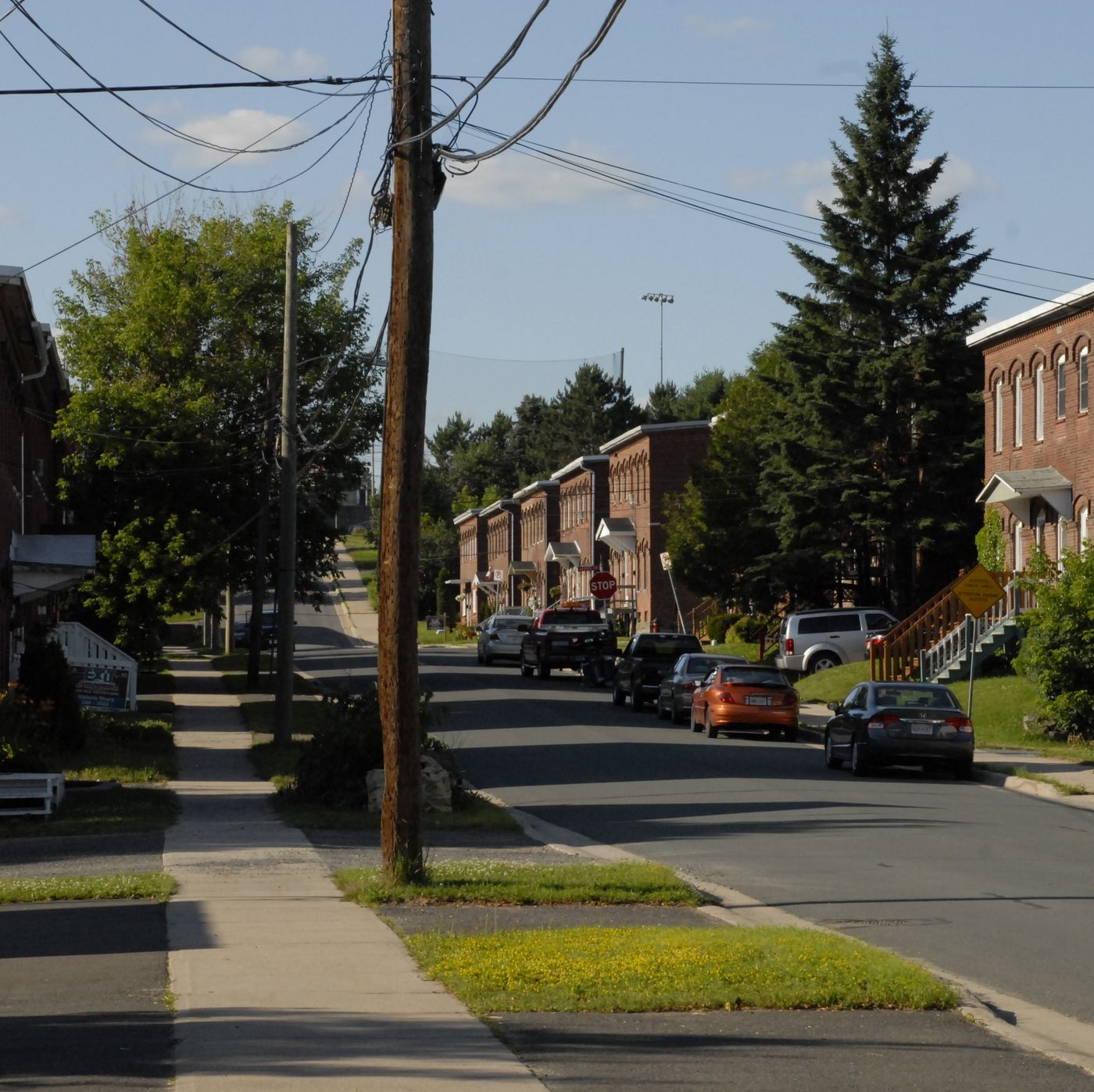
Now walk the workers’ town. Bridge, Morrison, Allen and Downing streets carry the great brick rows: 53 two-storey houses, mostly duplexes, symmetrical, gable-roofed, astonishingly consistent because they were all built by one owner from one brickyard in one burst of construction. These are private homes, so admire from the sidewalk, but do notice the small differences (the five duplexes rebuilt after the 1920 fire, a modern porch here and there) that mark 140 years of families making company housing their own. On a corner lot among the rows stands the old three-storey brick boarding house where the single millwomen lived, and on Mill Street the former Gibson company store. Down along River Street is the older, humbler layer: the surviving wood-frame duplexes of the White Row lineage, the lumber village that predates cotton.
Then climb to Canada Street, which everyone here calls Nob Hill without irony. The 19 managers’ and merchants’ houses, 17 of wood and 2 of brick, are Maritime vernacular with pretensions, and their placement is the whole lesson: above the rows, catching the breeze, looking down on the mill. Finish at the spiritual layer: Gibson Memorial United Church with its great spire, and the Alexander Gibson Memorial Cemetery at 351 Canada Street, where the Gibson family plot forms an unusual circle of 27 markers around a white granite monument, a ring so distinctive the city designated it a Local Historic Place in 2010. Gibson’s own home, a Victorian manor-house with a ballroom and grounds tended by an English gardener, stood within sound of his mills; it did not survive, and its absence is the one hole in an otherwise complete picture.
Look at the streetscape as a system, not a collection of buildings. Managers’ hill, brick rows, boarding house, store, church, school, mill: you can stand at the corner of Bridge Street and read the entire social order of 1885 without opening a book. That legibility is precisely what Canada designated in 1993, and almost no other Canadian town offers it this intact.
Visiting Marysville, and why it will never quite be Fredericton
Practicalities first. Marysville is on Fredericton’s north side, about ten minutes’ drive from downtown: cross the Westmorland Street Bridge, follow the north shore east, and take Route 8 up the Nashwaak to the Marysville exits, or come in along Canada Street. The district is a living neighbourhood, free and open at all hours; the mill is a working government office building, so the grounds are accessible any time and the interior only on weekday business hours, with the upper floors off limits as workspace. The houses are private residences. Street parking is easy, the terrain is gentle, and the whole circuit described above is a comfortable hour and a half on foot. Heritage Fredericton has offered guided tours of the district in season, and the Fredericton Region Museum downtown holds Gibson material if the man himself gets under your skin, which he will. Check our events calendar for heritage walks and Marysville community events.
Go in the right frame of mind. This is not a museum village with costumed interpreters; it is a neighbourhood where people who grew up on mill wages, or whose grandmothers boarded at the hotel, still live in the rows. That is exactly why it feels different from every reconstructed heritage attraction you have ever visited. The “cotton mill smell” that longtime residents still describe lingered for decades after the looms stopped; the smell is gone now, but the town’s memory is not, and residents will talk about the Boss as if he might come striding up from the river at any moment, checking on his bricks.
And that is the last thing to understand before you visit: Marysville was amalgamated into Fredericton in 1973, but it was never really absorbed. It had its own industry, its own church, its own hill, its own dead, and fifty years inside city limits have not dented the conviction that Marysville is a place, not a subdivision. The designation in 1993 simply made official what everyone on Bridge Street already knew. Boss Gibson built a town so complete, so stubbornly coherent, that neither bankruptcy, nor closure, nor amalgamation, nor seven years of rain through a broken roof could unmake it. Walk it once and you will never again cross the Nashwaak without looking upriver for the tower.
Key takeaways
- The mill’s bricks were fired on site from Nashwaak clay in what the Dictionary of Canadian Biography calls one of the largest brickyards in Canada, directed by expert workmen from Ontario, with the bricklaying overseen by Captain Kelsey Mooney of Saint John.
- The mill carried 800 electric lights in 1885, the first to be installed anywhere in the Fredericton area, plus sprinklers and steam heat.
- To celebrate completion, Gibson hosted a Boxing Day 1885 dinner for more than a thousand employees and their families, with one turkey for every four people plus plum pudding, oranges, apples and grapes.
- Gibson kept hellfire out of the pulpit of the church he built, prompting millhand Louis Joseph King to call him “a kind of Protestant pope.”
- After quarrelling with his partner Jabez Snowball, Gibson boycotted the Canada Eastern in 1893 and hauled freight between Marysville and Fredericton by horse team.
- The rescue came before the honours: the province began converting the derelict mill into Marysville Place offices in 1985, the mill was designated a National Historic Site in 1986, and the whole district followed only in 1993.
- An Acadian village called Sainte-Marie stood near this stretch of the Nashwaak until it was burned in 1758, a full century before a different Mary gave Marysville its name.
Common questions
Is the Marysville Historic District free to visit?
Yes. The district is an ordinary living neighbourhood, so the streets are open at all hours at no charge. The mill, now the Marysville Place government office building, is generally accessible only at ground level during weekday business hours, and the rowhouses are private homes best admired from the sidewalk. Heritage Fredericton has offered guided tours of the district in season.
What church did Boss Gibson build in Marysville?
The Marysville Methodist Church, dedicated in January 1873, a decade before the cotton mill. A Toronto Globe correspondent called it “probably as fine a specimen of pure Gothic as can be found in America.” It survives today as Gibson Memorial United Church. Despite the town’s name, it was never dedicated to St. Mary; Gibson was a staunch Methodist, and Marysville honours his wife and eldest daughter, both named Mary.
When did the Marysville cotton mill close?
Three times. The looms stopped in 1954 as foreign competition squeezed the Canadian industry, again in 1973, and finally in 1975, when the last operator, Whittaker Textiles, cited soft markets, high raw material costs and foreign competition. Parks Canada documents round the end to “the late 1970s,” but 1975 is the date supported by closure scholarship and local record.
Is Marysville a National Historic Site?
Twice over. The cotton mill itself was designated a National Historic Site of Canada on June 16, 1986, shortly after the province began restoring it as offices, and the entire surrounding district received its own designation on November 20, 1993 as a rare intact 19th-century company town. Alexander “Boss” Gibson was also named a National Historic Person in 2007.
Can you go inside the old cotton mill?
Partly. Since its restoration began in 1985 the mill has been Marysville Place, a working Government of New Brunswick office building, so the upper floors are workspace. The grounds are open at all times, and the building is generally accessible at ground level during weekday business hours.
How do I get to Marysville from downtown Fredericton?
It is about a ten-minute drive: cross the Westmorland Street Bridge, follow the north shore east, then take Route 8 up the Nashwaak to the Marysville exits, or come in along Canada Street into the heart of the district. Street parking is easy, and the full street-by-street walk takes about ninety minutes.

Get the Hey Freddy week ahead, every Monday
Fredericton’s events for the week, in one short email. Free, unsubscribe anytime.
Sources & further reading
This guide reflects the documented local consensus, reporting, reviews and community voices, verified where possible. Things change; if we’re out of date, tell Freddy.
- Marysville Historic District National Historic Site of Canada, Canadian Register of Historic Places
- Marysville Cotton Mill National Historic Site of Canada, Canadian Register of Historic Places
- Marysville Historic District, Parks Canada Directory of Federal Heritage Designations
- Marysville Cotton Mill, Parks Canada Directory of Federal Heritage Designations
- Alexander Gibson (“Boss”), National Historic Person, Parks Canada
- GIBSON, ALEXANDER, Dictionary of Canadian Biography, vol. 14
- Boss Narratives: Regeneration and Heritage in Marysville, New Brunswick, Deindustrialization Studies
- Part of historic former cotton mill in Marysville to be demolished, CBC News
- Boss Gibson’s Marysville, National Historic Site, Fredericton Capital Region Tourism
- Alexander Gibson (aka Boss Gibson), Fredericton Region Museum
- Gibson Family Plot, Canadian Register of Historic Places
- Gibson Memorial United Church
- Marysville Cotton Mill, Wikipedia
- Marysville, New Brunswick, Wikipedia