 ™
™
Guides · 🏙️ City life
The House That Refused to Die: Old Government House and Two Centuries on St. Anne’s Point
Old Government House at 51 Woodstock Road is Fredericton’s great survivor: a sandstone Palladian mansion built 1826 to 1828 by barrack master turned architect John Elliott Woolford, on ground that held a Wolastoqey gathering place and the Acadian village of Pointe Sainte-Anne, burned in 1759. Home to fourteen lieutenant-governors, stage for a Confederation showdown on April 7, 1866, then deaf school, soldiers’ hospital, and RCMP headquarters for more than half a century, it was meticulously restored and reopened as the vice-regal residence on July 1, 1999. Free guided tours run all summer.
Why This Sandstone Mansion Matters More Than It Lets On
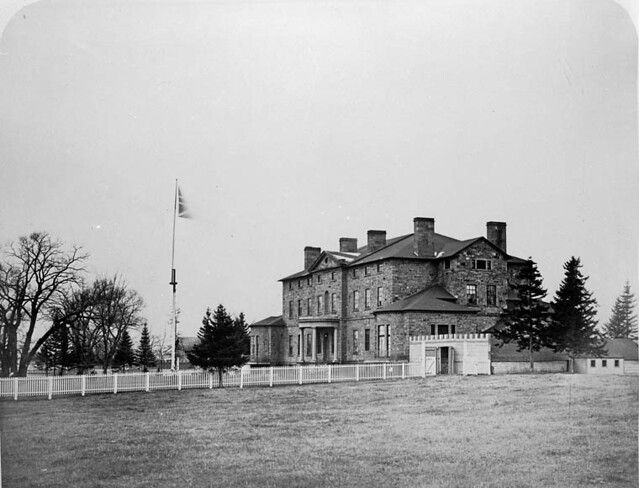
Drive west out of downtown Fredericton along Woodstock Road and you pass it in about eight seconds: a long, low, honey-grey stone house set back on a lawn that rolls down toward the river. Most of us have done that drive a thousand times. What you are passing is one of the oldest purpose-built vice-regal residences in Canada, a National Historic Site since 1958, a building where a heated encounter on April 7, 1866 helped tip New Brunswick into Confederation, and a piece of ground whose human story runs back not two centuries but many thousands of years.
Old Government House is the rare heritage building that has lived several complete lives. It has been a colonial governor’s palace, a school for deaf children, a barracks, a soldiers’ hospital, and for more than five decades the provincial headquarters of the Royal Canadian Mounted Police. It came within a whisker of permanent institutional oblivion, spent decades as the subject of committee reports and public hand-wringing, and then, against every odd, got the fairy-tale ending: a painstaking restoration and a return to its original job. Since July 1, 1999, the Lieutenant-Governor of New Brunswick has once again lived and worked under Woolford’s hipped roof.
That arc alone would earn it a feature. But the deeper reason this site matters is the ground itself. The mansion stands on St. Anne’s Point, on land the Wolastoqiyik have known since long before any European sail appeared on the Wolastoq, and directly on the site of Pointe Sainte-Anne, the Acadian village that New England rangers burned to the snow in February 1759. The provincial heritage record notes an early burial ground on these grounds where both Wolastoqiyik and Acadian people lie. No other single property in the city stacks Fredericton’s whole layered story, Indigenous, Acadian, Loyalist, colonial, modern, quite so vertically. If you want the city in one place, this is the place.
Before the Mansion: Thousands of Years, Then a Village Burned in the Snow
Begin where the record begins, which is long before 1826. The point of land where the mansion sits was part of the Wolastoqey world, a stopping and gathering place on the great river highway the Wolastoqiyik call the Wolastoq, “the beautiful and bountiful river.” Archaeology across the Fredericton reach of the river has turned up evidence of Indigenous presence stretching back millennia, and the Government House grounds sit squarely within that ancient landscape. For the fuller Indigenous story of the city, see our guide to Wolastoqey Fredericton.
In 1692, Acadian settlers established a village here called Pointe Sainte-Anne, on unceded Wolastoqey territory. It grew into a farming community of roughly one hundred people, with houses, barns, and livestock strung along the riverbank. Its leading figure was Joseph Godin dit Bellefontaine, captain of the Acadian militia on the St. John River who also served the French Crown as an interpreter of Indigenous languages, a detail that says everything about how intertwined Acadian and Wolastoqey life was on this stretch of river.
Then came February 18, 1759. In the brutal winter campaigns that followed the fall of Louisbourg, a force of New England rangers under Lieutenant Moses Hazen marched upriver and destroyed the village utterly, burning 147 buildings along with the food and livestock, and killing inhabitants, including women and children, some of whom were scalped. The violence was extreme even by the standards of the day: both Monckton and Amherst disapproved of Hazen’s conduct, with Monckton condemning the raid as barbarous. Godin himself survived, only to be deported repeatedly and to die in poverty in France. Other survivors fled toward Quebec and the Miramichi. Some families eventually came back, and their descendants, bearing names like Goodine, Martin, and Damour, still live in Fredericton today.
The mansion’s grounds hold the physical memory of all of this. The provincial heritage designation records an early burial ground on the property where both Wolastoqiyik and Acadian people are buried, and excavations east of the house have uncovered the buried foundation of an Acadian home. When you stand on that tidy vice-regal lawn, you are standing in the middle of what was, for sixty-seven years, somebody’s village.
Fire, Ash, and an Ambitious Governor
The colonial chapter starts with Thomas Carleton, New Brunswick’s first governor, who acquired land at St. Anne’s Point and in 1787 had a wooden residence built for himself, the “Mansion House,” raised by local builders Van der Beck and Ackerman. In 1816 the provincial government bought the house and its fifty acres between Woodstock Road and the river from the Carleton estate for £3,500, plus another £250 to clear a lease held by the College of New Brunswick, making it the official governor’s residence.
Enter Sir Howard Douglas, who arrived as lieutenant-governor in 1824 and proved to be one of the most energetic administrators the colony ever had. He championed King’s College, the ancestor of UNB, pushed roads and education, and generally behaved like a man determined to leave marks. Fate handed him his biggest opportunity in the catastrophic autumn of 1825. That October, the Great Miramichi Fire devastated close to a quarter of New Brunswick, and its southern edge tore through Fredericton on October 7, consuming roughly a third of the town. Douglas earned lasting local admiration for personally directing the firefight and the organized retreat, complete with defensive ditches, that finally stopped the flames.
But the old Governor’s Mansion House was already gone by then. It had burned about two weeks earlier, in a separate blaze in that same terrible season, and contemporary accounts credit Douglas with charging into the burning building himself to rescue vital state papers. The Parks Canada plaque on today’s building states it plainly: the new house replaced an earlier governor’s residence of 1787 which was “destroyed by fire in 1825.” Douglas, homeless in office and never one to think small, resolved that its replacement would not be another wooden house but a proper stone mansion worthy of a British colonial capital.
A tidy piece of symmetry: Sir Howard Douglas laid the cornerstone of the new Government House on July 1, 1826. The restored house reopened as the vice-regal residence on July 1, 1999, one hundred and seventy-three years later to the day. Nobody planned the first date with Canada Day in mind, since Canada was still forty-one years from existing.
Woolford’s Masterwork: The Build of 1826 to 1828
The man Douglas turned to was not, strictly speaking, an architect at all. John Elliott Woolford, born in London in 1778, was a soldier-artist who had served in the victorious campaign against Napoleon’s army in Egypt, where his sketching talent caught the eye of the Earl of Dalhousie. Dalhousie became his lifelong patron, bringing Woolford to Nova Scotia in 1816 as his official draughtsman. In Halifax, Woolford produced celebrated aquatint views and topographical works, and he is credited with designs for Dalhousie College. In 1823 he moved to New Brunswick, first as assistant barrack-master at Saint John, then as barrack master general at Fredericton, an appointment he held for thirty-six years. Designing buildings was, in effect, his brilliant side hustle.
For Douglas he produced a design in the Palladian manner, filtered through Regency and Adamesque taste: a symmetrical two-and-a-half storey main block of seven bays under a hipped roof with tall chimneys, flanked by lower semi-circular end bays, with a pedimented frontispiece, a semi-circular portico, and side and over-lights marking the entrance. The walls went up in locally quarried sandstone, the multi-light sash windows set out in disciplined, evenly spaced ranks across symmetrical facades. The riverside elevation got a full-height central bay looking over the Wolastoq. Construction ran from the cornerstone ceremony of July 1, 1826, until completion in 1828, when Douglas and his family moved in.
Inside, Woolford gave the house a formal centre-hall plan, with an entry hall framed by Tuscan columns finished in faux marble, and door and window trim carved in an ornate Regency pattern that survives throughout the house to this day. Sections of the ballroom’s original painted plaster, dating to about 1830, still exist behind hinged protective panels, one of the restoration’s loveliest reveals. Woolford was not finished with Fredericton either: he went on to design the Old Arts Building at King’s College (1828 to 1829), now Sir Howard Douglas Hall at UNB, and the county jail of 1830. He died in Fredericton in 1866, having quietly shaped more of the city’s face than almost anyone.
Balls, Intrigue, and the Encounter That Helped Make Canada
For sixty-five years, from 1828 to 1893, Government House was the social and ceremonial summit of New Brunswick. Fourteen lieutenant-governors lived here in succession, and the house hosted the state dinners, levees, balls, and garden parties that structured colonial society. Invitations were currency. The house saw royalty too: the Prince of Wales, the future Edward VII, passed through Fredericton on his 1860 North American tour, at the height of the house’s ceremonial glory.
But the event that put this building into the national story happened on April 7, 1866. New Brunswick’s government at the time was led by Albert J. Smith, head of the anti-Confederation party that had thumped Samuel Leonard Tilley’s pro-union side in the 1865 election. The lieutenant-governor, Arthur Hamilton Gordon, a restless Colonial Office aristocrat under pressure from London to deliver union, decided to force the issue. When the Legislative Council produced a strongly worded pro-Confederation address, Gordon received and answered it without his premier’s consent, a constitutional slap in the face. The confrontation between Gordon and Smith at Government House precipitated exactly what Gordon intended: Smith’s government resigned within days, an election followed, and, with Fenian raiders conveniently menacing the border during the campaign, Tilley’s pro-Confederation forces swept back into power, taking thirty-three seats to the anti-confederates’ eight. The Parks Canada plaque on the house credits that April 7 encounter with having “prepared the way for the Union of the provinces.”
It is worth pausing on how strange this is. Confederation is usually told as a story of Charlottetown and Quebec City and London. But one of its genuine hinge moments was an angry conversation in a sandstone house on Woodstock Road, between a governor behaving badly and a premier who never forgave him. Gordon went on to govern Trinidad, Mauritius, Fiji, New Zealand, and Ceylon. Smith went on to federal cabinet as Minister of Marine and Fisheries and, in 1878, a knighthood. The room they argued in is on the tour.
Abandoned: The Long, Odd Afterlife
The house’s fall from grace was not dramatic. It was budgetary. After Confederation, the office of lieutenant-governor shrank in both importance and income, and by the early 1890s the province, chronically short of money, balked at the cost of running a mansion. Sir Samuel Leonard Tilley, serving his second term as lieutenant-governor, was the last vice-regal resident of the era; when his tenure ended in 1893, the government gave the house up rather than fund its upkeep, formally abandoning it as the official residence in 1894. For more than a century afterward, New Brunswick’s lieutenant-governors lived in rented and borrowed quarters around town.
What followed was one of the strangest career changes any Canadian mansion has endured. From 1896 to 1900 the ballrooms and drawing rooms housed a residential school for deaf children, carrying the blunt institutional name of the day, the Institute for the Deaf and Dumb. With the outbreak of the First World War, the military moved in: the Canadian Expeditionary Force occupied the property from 1914 to 1921, using it as barracks, and the house continued as a hospital for returned soldiers through 1924. Wounded men convalesced in rooms built for quadrilles.
Then came the Mounties. The Royal Canadian Mounted Police made Old Government House the headquarters of “J” Division, its New Brunswick command, from 1934 until 1988. The Office of the Lieutenant-Governor’s own history gives those dates, though some heritage listings bracket the era slightly differently, starting it as early as 1932; where the records disagree, we defer to the official house history. For over five decades the state rooms held offices, files, and police operations, and generations of Frederictonians knew the building not as a mansion but simply as a police headquarters. When J Division finally moved out in 1988, a story we touch on in our 1980s retrospective, the old house stood empty, worn, institutionally scarred, and facing the most dangerous condition any heritage building can face: no purpose.
Decades of Debate, Then the Save of the Century
The building’s value was never exactly a secret. The Historic Sites and Monuments Board had seen to that on May 27, 1958, when Old Government House was designated a National Historic Site of Canada, cited as “an elegant Palladian mansion” closely associated with the Confederation movement. But a plaque does not pay for a roof, and through the late 1980s and early 1990s the empty house became Fredericton’s favourite unresolved argument. Proposals came and went: museum schemes, office conversions, various adaptive reuses. Committees studied. Reports accumulated. The house waited, and buildings that wait tend to lose.
What saved it was a convergence of will in the mid-1990s. In 1996 the province designated the property under its heritage protection legislation, and all three levels of government lined up behind a full restoration with a purpose attached: the house would go back to being exactly what Woolford built it to be, the residence and office of the lieutenant-governor. Renovation work began in May 1997 and ran roughly two years, a meticulous campaign that stabilized the sandstone, recovered the interior finishes, preserved the surviving circa 1830 plasterwork, and threaded modern mechanical, accessibility, and security systems through a Regency shell without wrecking it.
The restoration years also opened the ground. Archaeological work around the house confirmed what the documentary record promised: evidence of the Acadian village, including a buried house foundation east of the mansion, along with the site’s deeper Indigenous story. The province’s heritage listing now explicitly recognizes the Acadian settlement of Sainte-Anne, destroyed in 1759, and the early burial ground where both Wolastoqiyik and Acadian people are buried, as part of the site’s protected heritage value. The lawn, in other words, is now legally what it always was in fact: layered ground.
On July 1, 1999, Government House reopened and Lieutenant-Governor Marilyn Trenholme Counsell took up residence, the first vice-regal occupant in one hundred and six years. The house that had been a school, a barracks, a hospital, and a police headquarters was, at last, a home again.
What You Will Actually See Today
Today the house leads a double life, and the tour lets you see both. It is a working official residence, where the lieutenant-governor swears in ministers, invests members of the Order of New Brunswick, receives the premier, and hosts state dinners. It is also, in the words of the region’s tourism authority, “a museum, gallery, heritage site and community resource.” The main floor holds the formal state rooms, restored to period elegance and furnished with New Brunswick and British antiques, many of them original to the house. An interpretation centre tells the story of the building and of the city and province around it, and upstairs an art gallery features the work of New Brunswick artists, while the vice-regal family’s private apartment occupies the top of the house.
Watch for the details that reward a slow visit. The Tuscan columns of the entrance hall, finished in faux marble, are original Woolford, as is the Regency-carved trim that runs around doors, windows, and arches through the whole house. In the ballroom, ask about the hinged panels that guard sections of the original painted plaster from around 1830, actual surfaces that Douglas-era guests danced past. The exhibit spaces interpret the site’s full arc, from Wolastoqey and Acadian ground through the vice-regal, institutional, and police eras to the restoration.
Outside, walk the grounds. The 4.5-hectare estate sweeping down toward the Wolastoq is one of the finest riverbank settings in the city, and it regularly hosts public celebrations for occasions like Canada Day and New Brunswick Day. Near the house stands the Buttery, a circular stone outbuilding of about 1838 with a conical roof, the only nineteenth-century outbuilding to survive, looking like something out of a storybook. And remember what the provincial designation records beneath the grass: the burial ground, the Acadian foundations, the deep Indigenous past. Few lawns in Canada carry more. If this whets your appetite, our museums and heritage guide maps the rest of the city’s time machines.
For the ghost-curious: a house this old, with this many lives, naturally trails stories. Staff and visitors over the years have traded tales of unexplained footsteps and presences, which we sift with appropriate skepticism in our haunted Fredericton guide. The documented history, frankly, is stranger than the folklore.
Visiting: Tours, Hours, and the Riverbank Walk
Here is the practical beauty of Old Government House: it is free. The house offers complimentary guided tours in both English and French through the summer season, generally from early June until around the end of August, between 10 a.m. and 4 p.m., with tours by appointment the rest of the year. The weekly schedule shifts from season to season, sometimes Monday to Saturday, sometimes weekdays only, and because this is a working official residence, tour times can also change without notice when state functions are on. Call ahead at 506-453-2505 to confirm. The civic address is 51 Woodstock Road, an easy walk from downtown along the riverfront trail.
Build it into a bigger outing. The house sits right on Fredericton’s riverfront trail system, so you can walk or cycle from Officers’ Square and the Garrison District in about fifteen minutes, with the Wolastoq for company the whole way. Pair it with the Beaverbrook Art Gallery and the Legislative Assembly for a full heritage day, or come on Canada Day or New Brunswick Day when the grounds open up for public celebrations and the house is at its most alive. The grounds themselves are open to the public, and the view from the lawn across the river at golden hour is quietly one of the best free experiences in the city.
A last thought before you go. Stand on the portico steps and run the tape backward: Marilyn Trenholme Counsell arriving in 1999; the Mounties’ files and radios; the soldiers of 1914; deaf children at their lessons; Gordon and Smith’s raised voices on April 7, 1866; Douglas laying his cornerstone in 1826; the flames of two fires in one terrible season; the Acadian farms of Pointe Sainte-Anne burning in the February dark of 1759; and beneath it all, the Wolastoqiyik, who knew this point of land first and are part of its story still. No building in Fredericton has survived more, or carries more. Go let it tell you about itself; the tour guides are excellent, and admission costs exactly nothing. For more of the city’s layered past, browse our full heritage section.
Key takeaways
- The cornerstone was laid on July 1, 1826, and the restored house reopened on July 1, 1999, one hundred and seventy-three years apart to the day.
- The designer, John Elliott Woolford, was not a professional architect but Fredericton’s barrack master general, a soldier-artist whose talent was discovered during the Egyptian campaign against Napoleon’s army.
- Sir Howard Douglas reportedly ran into the burning 1787 Governor’s Mansion House in 1825 to rescue state papers, about two weeks before the Great Miramichi Fire’s southern edge burned a third of Fredericton on October 7.
- The grounds contain an early burial ground where both Wolastoqiyik and Acadian people are buried, and archaeologists have found the buried foundation of an Acadian house east of the mansion.
- On February 18, 1759, rangers under Lieutenant Moses Hazen burned 147 buildings at the Acadian village of Pointe Sainte-Anne on this site, conduct that both Monckton and Amherst condemned.
- Sections of the ballroom’s original painted plaster from about 1830 survive behind hinged panels, and the circular stone Buttery of about 1838 is the last nineteenth-century outbuilding standing.
- The RCMP ran its provincial J Division headquarters from the mansion from 1934 to 1988, meaning many living Frederictonians knew the vice-regal ballroom as police office space.
Common questions
Can you visit Old Government House, and does it cost anything?
Yes, and it is free. Guided tours in English and French run through the summer, generally early June until around the end of August, between 10 a.m. and 4 p.m., and by appointment the rest of the year. Because it is a working official residence and the weekly schedule varies, call ahead at 506-453-2505 to confirm. The grounds at 51 Woodstock Road are open to the public.
When was Old Government House built and who designed it?
It was built between 1826 and 1828, with Sir Howard Douglas laying the cornerstone on July 1, 1826. The designer was John Elliott Woolford (1778 to 1866), Fredericton’s barrack master general and a protégé of the Earl of Dalhousie, who also designed the Old Arts Building at what became UNB. It replaced the 1787 governor’s residence destroyed by fire in 1825.
Why is it called “Old” Government House if the lieutenant-governor lives there now?
The name stuck during the century after 1893 when the house was not the vice-regal residence and served as a deaf school, barracks, hospital, and RCMP headquarters. The federal historic site designation of 1958 used the name “Old Government House,” and it remains in common use even though the building returned to vice-regal service in 1999.
What happened at Old Government House during Confederation?
On April 7, 1866, Lieutenant-Governor Arthur Hamilton Gordon confronted anti-Confederation Premier Albert J. Smith after accepting a pro-union address from the Legislative Council without his premier’s consent. Smith’s government resigned within days, the pro-Confederation side under Samuel Leonard Tilley won the ensuing election decisively, and New Brunswick’s path into Confederation was cleared. The Parks Canada plaque credits the encounter with having prepared the way for union.
Is Old Government House a National Historic Site?
Yes. It was designated a National Historic Site of Canada on May 27, 1958, recognized as an elegant Palladian mansion closely associated with the Confederation movement. The province also designated it under its heritage protection legislation in 1996, ahead of the 1997 to 1999 restoration.
What was on the site before the mansion?
The grounds sit on St. Anne’s Point, long part of the Wolastoqey homeland along the Wolastoq. From 1692 it held the Acadian village of Pointe Sainte-Anne, home to roughly one hundred people, until rangers under Moses Hazen burned its 147 buildings on February 18, 1759. A burial ground holding both Wolastoqiyik and Acadian people remains on the property.

Get the Hey Freddy week ahead, every Monday
Fredericton’s events for the week, in one short email. Free, unsubscribe anytime.
Sources & further reading
This guide reflects the documented local consensus, reporting, reviews and community voices, verified where possible. Things change; if we’re out of date, tell Freddy.
- Parks Canada Directory of Federal Heritage Designations: Old Government House National Historic Site
- Canadian Register of Historic Places: Old Government House National Historic Site of Canada
- Canadian Register of Historic Places: Old Government House (provincial designation)
- Office of the Lieutenant-Governor of New Brunswick: History of Government House
- Dictionary of Canadian Biography: John Elliott Woolford
- CBC News: Massacre of Acadians ‘forgotten’ aspect of Fredericton’s history
- Fredericton Region Museum: Pointe Sainte-Anne 1692–1759
- Fredericton Capital Region Tourism: Government House
- Fredericton Capital Region Tourism: Government House Guided Tours
- The Canadian Encyclopedia: New Brunswick and Confederation
- Dictionary of Canadian Biography: Sir Albert James Smith
- MyNewBrunswick: Old Government House Fredericton
- MyNewBrunswick: Fredericton in Flames, October 7, 1825
- Wikipedia: Government House (New Brunswick)