 ™
™
Guides · 🏙️ City life
Fredericton in the 1990s: Dial-Up, the Farm-Team CH, and the Last Train Across the River
If you grew up in Fredericton in the 1990s, you remember a city that felt small and suddenly wired. The Fredericton Canadiens wore the CH at the Aitken Centre from 1990 to 1999, Harvest Jazz & Blues was born downtown in 1991, Woolco became Walmart at the Regent Mall after the great retail takeover of 1994, NBTel’s dial-up internet screeched into living rooms in 1995, and in 1997 the old railway bridge reopened as the walking bridge. By New Year’s Eve 1999, almost everything had changed.
The city you woke up in, 1990
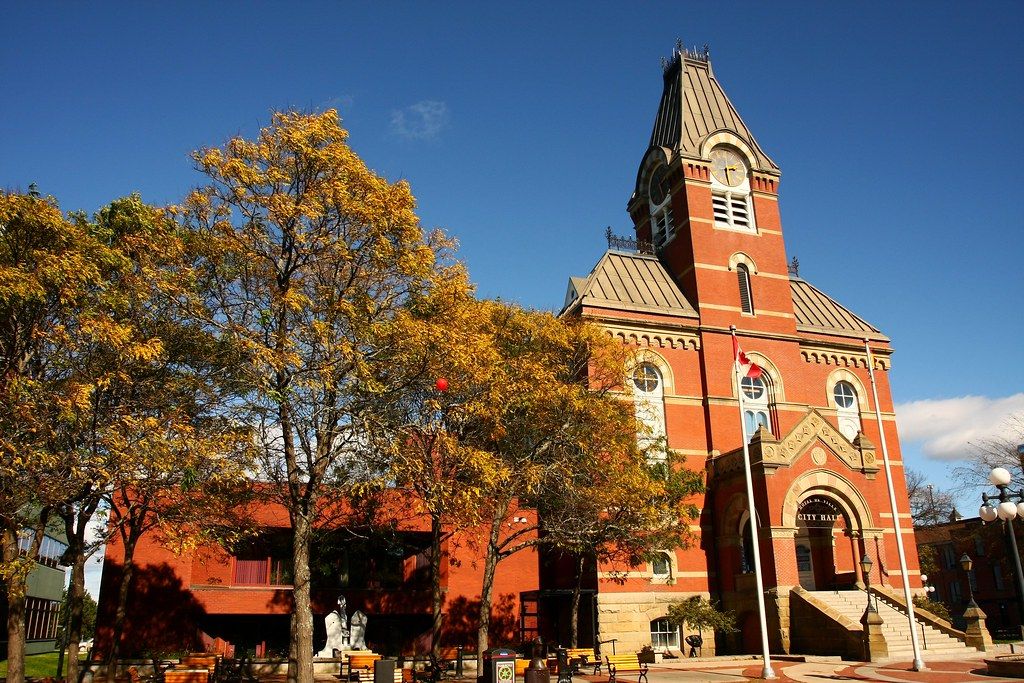
Start at the beginning of the decade, on any weekday morning. Fredericton in 1990 was a government town with elm-lined streets, a wide brown river through the middle of it, and a downtown where you could still park on Queen Street without circling the block twice. Frank McKenna had been premier for three years, having won every single seat in the legislature in 1987, and the province was in the middle of reinventing itself around telephones and technology. You could feel it coming, though nobody would have said so out loud at the Diplomat over breakfast.
The railway bridge still carried freight across the Saint John River then, the low rumble of trains a sound so ordinary that nobody thought to record it. Up in Marysville, the great brick cotton mill that Boss Gibson built in the 1880s had been silent as a textile operation for years, reborn as government office space, its rows of windows lit up with civil servants instead of loom workers. The north side and the south side were still stitched together mostly by the Westmorland Street Bridge, less than a decade old and still faintly novel.
The city’s rhythms were seasonal and dependable. Winter meant rink ice and wood smoke and the plow scraping past before dawn. Spring meant freshet watch, everyone glancing at the river and speaking knowledgeably about ice jams upstream. Summer meant band concerts and tourists photographing the Legislature. Fall meant the students pouring back up the hill to UNB and STU, doubling the energy of the place overnight.
What you could not know in 1990 was how much of the decade’s story would be about connection: a hockey team connecting Fredericton to the most famous franchise in the sport, a phone company connecting the province to the internet before most of the continent, a festival connecting downtown to the wider musical world, and finally, in 1997, an old rail bridge connecting the two halves of the city on foot. If the 1980s had been about building (the bridge, the malls, the bypass), the 1990s were about wiring everything together.
This is the decade as those of us who were there remember it: partly verified history, partly the smell of arena french fries, and partly the sound of a 28.8 modem trying to reach NBNet at eleven o’clock on a school night.
Wearing the CH: the Fredericton Canadiens at the Aitken Centre
When the Fredericton Express left for Halifax in 1988, after seven AHL seasons and a run all the way to the 1988 Calder Cup final, the Aitken Centre went quiet in a way that felt wrong. Then, in 1990, came news that still sounds improbable: the Montreal Canadiens were moving their farm team, the Sherbrooke Canadiens, to Fredericton. The CH, the actual bleu-blanc-rouge, would play its home games in a 3,565-seat university rink on the hill, a building that had only opened in 1976.
For nine winters, from 1990 to 1999, Fredericton was the last stop before the Montreal Forum. Patrice Brisebois played his first professional hockey here in 1990-91. Craig Rivet spent his first pro seasons here before sticking with Montreal in 1997-98. A young goalie named José Théodore minded the net at the Aitken Centre in the late 90s on his way to an NHL Hart Trophy. And Pierre Sévigny, who played here from 1991 to 1997, became the franchise’s all-time leader in both goals (106) and assists (136), the kind of player a small city adopts completely.
The hockey itself was often excellent and occasionally heartbreaking. The 1991-92 team posted the best record in the entire American Hockey League, 43 wins, 27 losses and 10 ties, and then lost in the first round to the Moncton Hawks, a defeat that still stings anyone who lived through it. Three years later the script flipped: the 1994-95 club finished under .500 in the regular season at 35-40-5, then caught fire in the playoffs and rode all the way to the Calder Cup final, where the Albany River Rats swept them in four.
But the standings were only half the point. The point was Friday night in the concourse, the cold walk up from the parking lot, the horn, the chance that the kid deking through centre ice might be on Hockey Night in Canada by spring. In a city this size, you did not watch prospects on television. You watched them from the fifth row, and when they got called up, it felt personal, like a neighbour making good.
Every autumn you checked the roster for names you knew. Every spring you said goodbye to a few of them. That was the deal, and Fredericton understood it. For nine years, this was a Canadiens town in the most literal sense possible.
Downtown on a Saturday morning
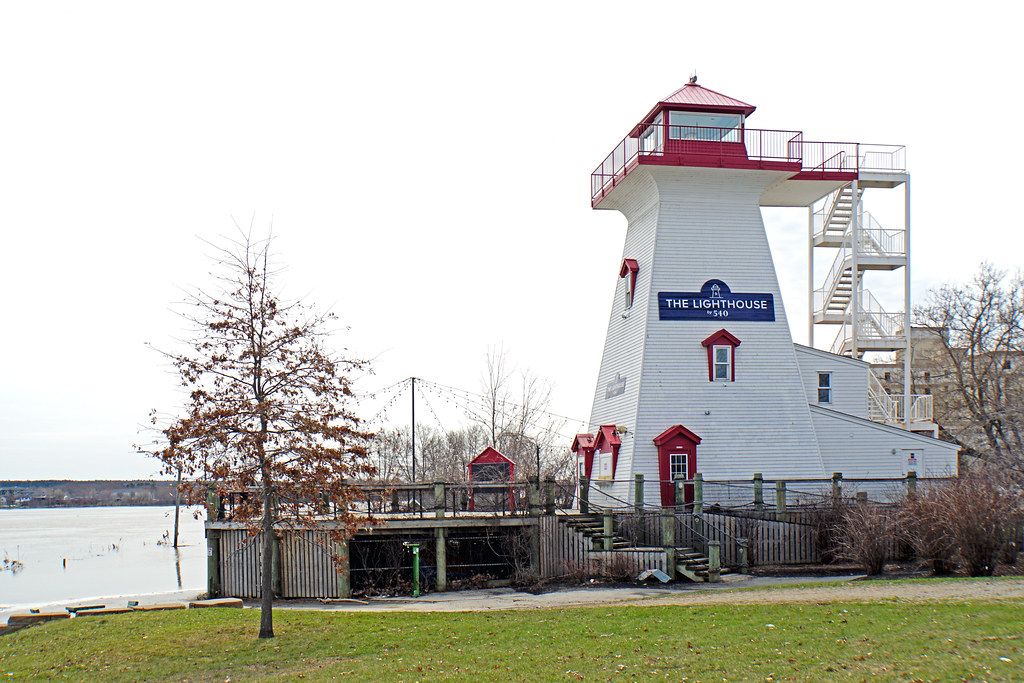
The week had an anchor, and it was the Boyce Farmers Market on George Street. Saturday mornings you moved through the crowd in a slow shuffle, coffee in one hand, brown paper bag in the other, past tables of bread and preserves and sausage, nodding at teachers and co-workers and that one guy from the rink. The market was where Fredericton performed being Fredericton, and in the 90s it needed no reinvention. It simply was, the same way the river was.
From the market you drifted downtown. Queen and King streets in the 1990s were a working downtown, not yet a heritage exhibit: banks and lawyers and lunch counters, Kings Place with its climate-controlled shortcut from King Street, record shops and clothing stores holding on gamely as the retail centre of gravity slid uphill toward Regent Street. Officers’ Square hosted its summer concerts and ceremonies by the river, brass and drums bouncing off the old stone barracks, a ritual that survives in updated form today (see our piece on the square’s modern comeback).
And in the York-Sunbury museum on that square sat the true celebrity of every school trip: the Coleman Frog. A creature said to have been coaxed up to forty-two pounds, so the story went, on a diet of whiskey, June bugs and buttermilk by hotelkeeper Fred Coleman at Killarney Lake in the 1880s, before meeting its end (the legend insists) in a dynamite mishap and coming back from a Maine taxidermist as the city’s strangest heirloom. By the 90s the frog had already survived its greatest indignity, a 1988 analysis by the Canadian Conservation Institute concluding the thing was canvas, wax and paint, a colossal fake. It did not matter. You filed past it in Grade 4, someone said “gross,” someone else swore it was real, and the debate continued on the bus. It continues still, which is exactly how Fredericton likes it (more on our museums in the heritage guide).
What you remember about downtown in that decade is its unhurried completeness. You could do your whole Saturday in twelve blocks: market, bank, records, a slice of pizza, the library, maybe the frog if your cousins were visiting. The mall was winning the retail war, everyone knew it, but downtown still felt like the city’s living room, and on market mornings it still does.
The premier with the phone: McKenna’s call-centre decade
You cannot tell the story of 1990s Fredericton without Frank McKenna, because for most of the decade New Brunswick’s story was his story. He had swept all 58 seats in 1987, an achievement so total that the legislature briefly had no opposition at all, and he governed like a salesman with the province as his product. His pitch was simple: New Brunswick had bilingual workers, a strong work ethic, and, crucially, the best telephone network on the continent. “The best social program we have is a job,” he liked to say, and he behaved as though every job in North America was personally negotiable.
That last part of the pitch was not bluster. In 1993, NBTel became the first telephone company in North America to operate a fully digital switching network. That infrastructure, plus aggressive courting from the premier’s office, brought the call centres: courier companies, financial firms, airlines and insurers routing their 1-800 traffic through New Brunswick office floors. Thousands of jobs arrived through the decade, many of them in and around Fredericton and Moncton and Saint John, filling office space and giving a generation of students and young parents their first headset.
Honesty requires the rough edges. Call-centre work was entry-level work, shift work, often modestly paid, and critics at the time asked whether an economy could be built on answering other people’s phones. Some of those jobs proved portable in exactly the way people feared. But in a decade when the cotton mills were long gone and wood and government could not absorb everyone, those paycheques were real, and downtown lunch spots noticed the difference.
McKenna left the way he arrived, on his own terms: he resigned in October 1997, ten years to the day after the election that had swept him in, honouring a promise almost nobody had expected him to keep, a piece of political theatre nobody here has matched since. Two years later NBTel itself disappeared into the new Atlantic-wide company called Aliant, and the era of the province’s own phone company, the one that had made the whole experiment possible, quietly ended with the decade.
Agree or disagree with the economics, the 90s made one thing true: Fredericton stopped thinking of itself as merely a pretty capital and started thinking of itself as a wired one. That self-image, which the city still carries, was built between 1987 and 1997.
Logging on: NBNet, dial-up and the sound of the future
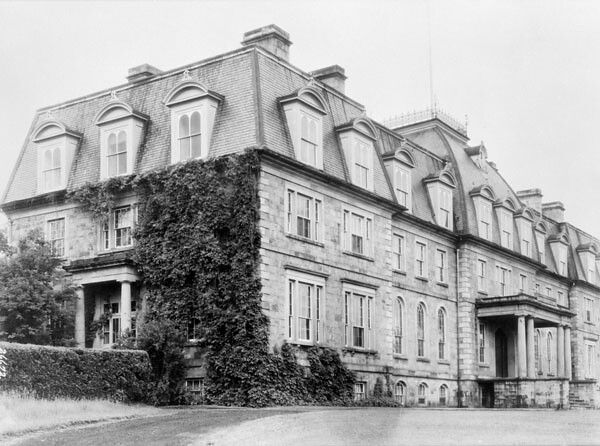
Somewhere in the middle of the decade, the future made a sound, and the sound was a modem handshake. NBTel’s internet service, NBNet, opened dial-up access to the public, and by the end of 1995 roughly ten thousand New Brunswick households and businesses had accounts, enough that the company was scrambling to spread modem banks across the province to keep up. UNB, plugged in through leased data lines, was ahead of nearly everyone; in 1995 the university’s Rick Hall organized the first NAWeb conference in Fredericton, one of the earliest gatherings anywhere devoted to teaching on the World Wide Web. Quietly, improbably, little Fredericton was early.
If you were a student, the internet lived in the computer labs: rows of beige machines at UNB and STU, the clatter of keyboards, the ten-minute wait for a single image to load, someone printing forty pages of song lyrics on the shared laser printer. If you were a household, the internet lived in the spare room, and it lived there conditionally, because going online meant seizing the family phone line. Entire domestic negotiations were conducted over this. You have not known injustice until your sister picked up the phone during hour three of a download.
Then came ICQ in 1996, and suddenly the point of the internet was each other. That flower logo, the “uh oh” of an incoming message, the string of digits you wrote on the back of your hand at school: for Fredericton teenagers this was the first social network, years before anyone used that phrase. You talked to the same people you had just seen at school, for hours, about nothing. It was magnificent.
Looking back, the remarkable thing is how unremarkable it felt at the time. The province that had bet its economy on telephone lines turned out to be exactly the right place to meet the internet early. The kids idling in ICQ chats over NBNet dial-up were the first draft of the tech workforce Fredericton talks about today. Every knowledge-park press release of the 2000s and 2010s has a little bit of 1995 in it, a beige tower humming in a spare room on a school night.
You know you grew up in Fredericton in the 90s if you memorized your best friend’s ICQ number but not their phone number, and you knew exactly which hour of the evening your NBNet connection was least likely to drop.
School days: portables, Black Kats and a silver medal
For most of the decade, if you were a south-side teenager, you went to Fredericton High School, and so did everybody else. FHS in the 90s was famously, absurdly big; the line repeated at every assembly, in every yearbook, was that it ranked among the biggest high schools in the Commonwealth. Whatever the precise truth of that claim, the lived reality was corridors like highway on-ramps, a bell schedule that functioned as crowd control, and the black and yellow of the Black Kats everywhere you looked.
The school produced its share of 90s glory. Marianne Limpert, who did her high-school years at FHS, swam the 200-metre individual medley at the Atlanta Olympics in 1996 and came home with a silver medal, and for one summer every kid at the Sir Max Aitken pool swam a little harder because of it. Matt Stairs, raised just up the road in Tay Creek and shaped on Fredericton-area ball diamonds, broke into the big leagues with the Montreal Expos in 1992 and began a Major League Baseball career that would run nearly two decades (both feature in our famous Frederictonians guide).
By mid-decade, though, the crowding at FHS had gone from a point of odd pride to a genuine problem, and the answer took shape across the river. Leo Hayes High School, named for the former Fredericton police marshal who had sold the province that land for a future school back in 1968, rose on the north side overlooking the Saint John, with construction finally starting in the summer of 1998, three decades after the deal. It opened its doors on September 7, 1999, with 962 students, and in one September the ancient equation of Fredericton adolescence, everybody funnels to Priestman Street, was rewritten. North-side kids suddenly had a school, and an identity, of their own.
School life around all this was standard-issue 90s Canadiana: MuchMusic Video Dance parties in the gym, ski trips to Crabbe Mountain, cafeteria fries with gravy, term papers that began at the card catalogue in 1991 and ended, by 1999, with a search engine and a prayer. The decade began with overhead projectors and ended with a computer lab booking sheet. Nobody thought to call it a revolution. It was just school.
The soundtrack: Harvest is born, the Monoxides get loud
In September 1991, a group of downtown believers staged a four-day festival of jazz and blues in whatever rooms they could find, including the inside of the Boyce Farmers Market. That was the first Harvest Jazz & Blues Festival. Nobody at those early shows could have told you that the thing would grow into the Maritimes’ great September ritual, with tents and street closures and tens of thousands of people treating downtown Fredericton like New Orleans North. Through the 90s it built itself year over year, act by act, volunteer by volunteer, until by decade’s end Harvest weekend had joined the market and the rink among the city’s load-bearing traditions (it lives on, renamed the Harvest Music Festival in 2021, every September; check our events calendar).
The louder end of the dial belonged to the kids. New Brunswick’s great 90s rock export was the Monoxides, Moncton boys who had formed as literal children in 1988 and grew into the region’s best live band, all hair and volume and hooks. Their 1995 EP Out of the Marsh got them signed, and 1997’s Galaxy of Stooges, produced by Moe Berg of The Pursuit of Happiness, put songs like “(Can’t Get) Excited” and “Little Bitta Rosie” on radio across the country. When they came through Fredericton, or when any touring band hit an all-ages hall show, you went, because in a small city every show mattered twice.
Radio stitched it together. CHSR 97.9, the campus station up the hill, played what commercial radio would not and let students say so on air. On the commercial side, the FM station that had signed on back in 1983 at 93.1 moved to 105.3 in 1992, and that spot on the dial became Fredericton’s home for rock, the frequency the city would come to know as The Fox. In the car, at the shop, at the rink warm-up: 105.3 was the default.
And when you were old enough, or claimed to be, there was the downtown night itself: King Street clubs shoulder to shoulder on a Saturday, Sweetwaters looming largest in the city’s collective memory of that era, lineups in the cold, the same forty songs, the walk home up the hill replaying all of it. Every city gets one decade where its nightlife feels mythic in retrospect. For a lot of Fredericton, the 90s were it.
Retail gravity: the Regent Mall decade
Every 90s Fredericton Saturday eventually bent toward the top of the hill. The Regent Mall had been there since 1976, but the 90s were the decade it became the undisputed centre of retail gravity, the place where the whole region parked, wandered, ate and ran into everyone it knew. The parking lot on a December Saturday was its own weather system.
The decade’s biggest retail moment arrived in 1994, when Walmart bought more than a hundred of Woolco’s Canadian stores and the Regent Mall’s familiar Woolco, red W, budget lunch counter and all, was reborn under the blue Walmart banner. It was Fredericton’s little share of a national upheaval, and everyone had an opinion: about the greeters, about the prices, about what an American giant meant for everybody else. Down the hill, the older Fredericton Mall on Prospect Street, the Zellers mall in most people’s shorthand, felt the shift first, beginning the long slow fade from centre of the action to convenience stop that would play out over the following decades. Downtown merchants felt it too, and said so.
Food was changing on the same streets. Tim Hortons, in the middle of its great national expansion, was multiplying across the city, steadily turning “coffee” and “Tims” into synonyms. And a homegrown story was unfolding on the north side: Pizza Twice, opened in Fredericton in 1989 as a single independent shop, spent the following years growing into an Atlantic Canadian chain that would eventually count eighteen stores, proof that a local counter could play the franchise game too.
Then there was Friday night, which in the 90s had a liturgy of its own: the video store. Whether it was the Blockbuster wall of new releases or a local shop with a beaded curtain to the horror section, the ritual was identical. You walked the aisles, you negotiated with your siblings, you gambled on a cover, you were told the movie you actually wanted was out, all twelve copies. Rewind fees were real. “Be Kind, Rewind” was law. Nobody streaming tonight will ever know the specific joy of finding the last copy of the movie everyone at school was talking about.
You know you grew up in Fredericton in the 90s if you can still picture the Woolco sign at the Regent Mall, and you remember exactly where the new releases wall was at your video store, and which direction you walked it.
The last train and the first walk across
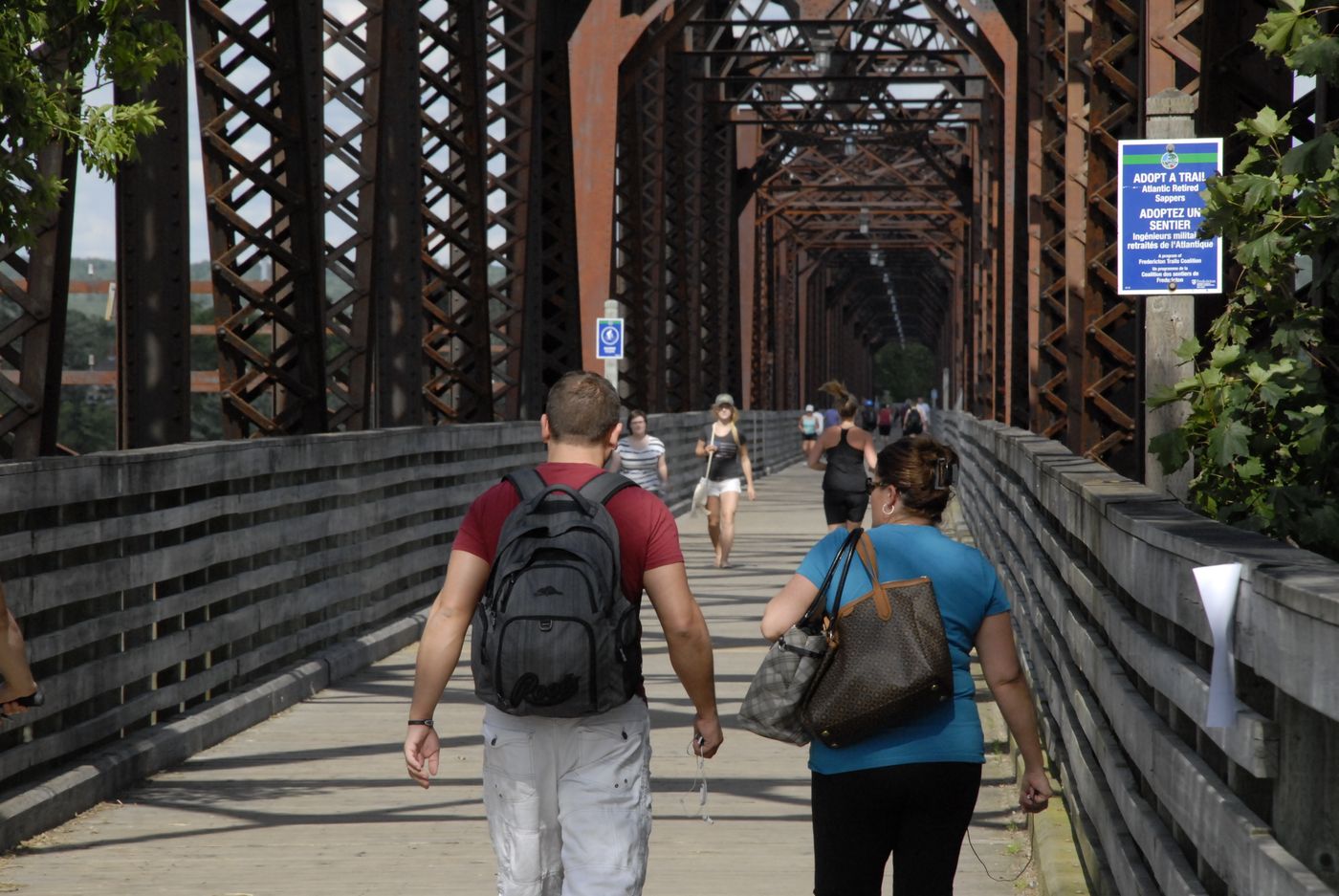
For over a century, the iron railway bridge below Devon had been part of Fredericton’s pulse. The first spans went up between 1887 and 1889, and the river made the bridge earn its keep: the great freshet of March 1936 wrecked it with ice and floodwater, and the rebuilt crossing that reopened on June 1, 1938 is essentially the structure you walk today. Through all of it, the sound of freight rolling over the water was city wallpaper: always there, never noticed. Then, in the mid-90s, the wallpaper came down. CN abandoned the line in 1995, and in March 1996 the last train crossed the river, an emergency shipment of coal bound for CFB Gagetown, of all the endings nobody would have written. After that, silence, and a very Fredericton question: what do you do with a perfectly good bridge to nowhere?
The answer turned out to be one of the best decisions the city ever made. In 1997 the old railway bridge reopened as a pedestrian crossing, 581 metres of decked walkway hanging over the river, knitting the downtown to the north side for anyone with working legs or a bicycle. What had been private infrastructure for freight became public space for everybody, and Fredericton took to it instantly: dog walkers, commuters, couples, kids on bikes, tourists stopping mid-span to photograph the water.
If you crossed it that first summer, you remember the novelty of standing in the middle of the river, in a place that had been forbidden your entire life, looking back at the church spires and the green and thinking the city had never looked so good. It became the default evening walk, the default first-date suggestion, the default “what should we do with the visitors” answer, and it has never stopped being any of those things.
The bridge got its formal name later, in 2008, honouring Bill Thorpe, a tireless champion of the city’s trail system. But its meaning was fixed in 1997. The decade that took the trains away gave the river back to the people walking above it, and every crossing since has been a small act of civic gratitude. It remains the single best free thing you can do in this city, in any decade (more river history in our heritage section).
Red glory: the Varsity Reds and the 1998 University Cup
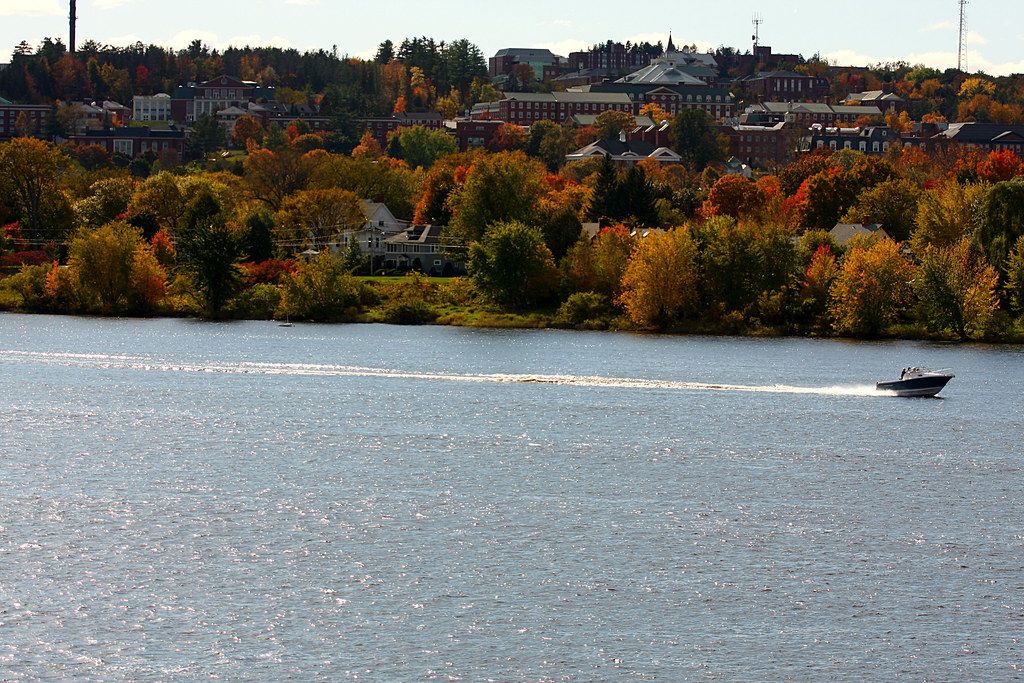
While the professional Canadiens filled the Aitken Centre’s marquee nights, the same building hosted the other great hockey story of the decade, and this one ended in a championship. UNB’s athletic teams, known through generations under a whole wardrobe of names (Red Devils, Red Bombers, Red Bloomers, Red Raiders), were gathered in the early 1990s under a single new banner: the Varsity Reds. Traditionalists grumbled, as traditionalists must, but the name stuck, and it was about to get lucky.
On March 29, 1998, in Saskatoon, the UNB Varsity Reds beat the Acadia Axemen 6 to 3 to win the CIAU University Cup, the first national men’s hockey championship in the university’s history. For a school and a city that had watched decades of good teams fall short, it was a threshold moment. The players came home champions, the banner went up, and something in the program’s self-image permanently changed.
Nobody watching in 1998 could have known just how completely that first title would be vindicated. UNB hockey went on to become the great dynasty of Canadian university sport, stacking national championships through the 2000s, 2010s and 2020s. Every one of those banners traces back to the first one, won by the 1997-98 team in a rink two time zones away while Fredericton listened and paced at home.
The 90s Aitken Centre, in other words, was arguably the best hockey building of its size in the country: an NHL farm team on some nights, a rising national power on others, university students in the stands either way, and the same cold walk back down the hill afterward. If you had a winter routine in this city, odds are it ran through that rink. For a lot of people it still does, and now the team is simply the UNB Reds, and the banners have needed more than one wall.
1999: the year everything ended at once
Decades rarely end on schedule, but Fredericton’s 1990s did. In 1999 the endings arrived in convoy. The Montreal Canadiens pulled their farm team out of Fredericton and moved it to Quebec City as the Citadelles; the economics were unarguable, since the 3,565-seat Aitken Centre had become a tiny anomaly in an AHL drifting toward 8,000 and 15,000-seat arenas, but the loss still landed like a breakup. Nine years of wearing the CH, of watching Brisebois and Rivet and Théodore before the rest of the country knew their names, over with a mid-season announcement in February and a quiet final home game in the spring.
That same year, NBTel, the province’s own phone company, the quiet engine behind the call centres and the dial-up decade, vanished into the Atlantic-wide merger that created Aliant. That September, Leo Hayes opened its doors and the one-high-school city officially became a two-high-school city. Even the calendar itself was ending theatrically, with Y2K filling the news: would the computers fail, would the lights stay on, should you fill the bathtub just in case. Fredericton stocked a few extra batteries, went to its parties, and woke up on January 1, 2000 to discover, like everyone else, that the world had rudely continued.
What actually ended that night was subtler than a computer glitch. The city that entered the 90s, a government town with a freight railway and one phone company and one high school and a farm team on the hill, did not exist anymore. In its place was a city with a walking bridge, a national-champion university team, a September music festival, a big-box retail strip, and thousands of households already living partly online.
Was it a better city? That is the wrong question to ask of a decade. It was a different city, built by the one before it, the way the walking bridge was built on the railway’s bones. If you were there, you carry the whole inventory anyway: the horn at the Aitken Centre, the modem screech, the market shuffle, the Woolco sign, the first walk across the river. Nobody who grew up here in the 90s needs this article to remember any of it. But it is nice, once in a while, to see it all written down (for more of the city’s story, start at our guides hub).
Key takeaways
- The Fredericton Canadiens went 43-27-10 in 1991-92, the best record in the entire AHL, and still lost the first playoff round to the Moncton Hawks.
- José Théodore, Patrice Brisebois and Craig Rivet all played at the 3,565-seat Aitken Centre before becoming Montreal regulars, and Pierre Sévigny remains the franchise’s all-time leader in goals (106) and assists (136).
- The first Harvest Jazz & Blues Festival in 1991 ran four days and used borrowed downtown venues, including the inside of the Boyce Farmers Market.
- The last train crossed the Fredericton railway bridge in March 1996, an emergency coal shipment for CFB Gagetown, and the same bridge reopened to pedestrians in 1997, over a decade before it was named for Bill Thorpe in 2008.
- NBTel ran the first fully digital telephone switching network in North America starting in 1993, and NBNet had about ten thousand dial-up customers by the end of 1995.
- Walmart’s 1994 takeover of Woolco’s Canadian stores converted the Regent Mall Woolco, the mall having anchored the top of the hill since 1976.
- Leo Hayes High School opened on September 7, 1999 with 962 students, ending the era when nearly every city teenager funnelled into Fredericton High School.
Common questions
What was the Fredericton Express?
The Fredericton Express was the city’s first AHL team, playing at the Aitken Centre from 1981 to 1988 as a farm club shared by the Quebec Nordiques and the Vancouver Canucks. They reached the Calder Cup final in their last season, 1987-88, losing to the Hershey Bears, then moved to become the Halifax Citadels. Two years later the Montreal Canadiens moved their farm team in, creating the Fredericton Canadiens.
When did the Fredericton Canadiens play, and why did they leave?
The Fredericton Canadiens were the Montreal Canadiens’ AHL affiliate from 1990 to 1999, playing at the Aitken Centre. They reached the 1995 Calder Cup final, where they were swept by the Albany River Rats. In February 1999 Montreal announced the franchise would move to Quebec City as the Quebec Citadelles, largely because the 3,565-seat Aitken Centre had become far smaller than the arenas the AHL was moving toward.
When did the Regent Mall open?
The Regent Mall opened in 1976 on Regent Street at the top of the hill. Its biggest 1990s moment came in 1994, when Walmart acquired more than a hundred Woolco stores across Canada and the mall’s Woolco was converted to a Walmart. Through the decade it cemented itself as the retail centre of gravity for the greater Fredericton area.
When did Fredericton’s walking bridge open?
The former railway bridge across the Saint John River was first built between 1887 and 1889, then wrecked by the March 1936 freshet and rebuilt, reopening on June 1, 1938. CN abandoned the line in 1995 and the last train crossed in March 1996. The bridge reopened as a 581-metre pedestrian crossing in 1997 and was renamed the Bill Thorpe Walking Bridge in 2008, honouring a founder of the Fredericton trail system.
When did the Harvest Jazz & Blues Festival start?
Harvest began in 1991 as a four-day festival held in existing downtown venues, including the inside of the Boyce Farmers Market. It grew steadily through the 1990s into the Maritimes’ signature September music event, and in 2021 it was renamed the Harvest Music Festival.
Did UNB win a national hockey championship in the 1990s?
Yes. On March 29, 1998, in Saskatoon, the UNB Varsity Reds defeated the Acadia Axemen 6 to 3 to win the CIAU University Cup, the university’s first national men’s hockey title. It launched what became the most successful program in Canadian university hockey, now competing as the UNB Reds.

Get the Hey Freddy week ahead, every Monday
Fredericton’s events for the week, in one short email. Free, unsubscribe anytime.
Sources & further reading
This guide reflects the documented local consensus, reporting, reviews and community voices, verified where possible. Things change; if we’re out of date, tell Freddy.
- Fredericton Canadiens (Wikipedia)
- 1990-1999 Fredericton Canadiens (Fun While It Lasted)
- Fredericton Express (Wikipedia)
- Fredericton Railway Bridge / Bill Thorpe Walking Bridge (Wikipedia)
- Harvest Jazz & Blues Festival (Wikipedia)
- 1998 CIAU University Cup (Wikipedia)
- NBTel (Wikipedia)
- My History of the Internet in New Brunswick: 1995
- Leo Hayes High School (Wikipedia)
- CFXY-FM (Wikipedia)
- The Monoxides: Biography
- Coleman Frog (Wikipedia)