 ™
™
Guides · 🏙️ City life
The House That Rose From the Ashes: The New Brunswick Legislature, Fredericton’s Grandest Survivor
On the night of February 25, 1880, fire gutted Province Hall, the seat of New Brunswick’s government since the early 1800s. The province had announced a design competition for a replacement just three weeks earlier, and two years later it opened the Legislative Assembly Building, a Second Empire showpiece by architect J.C. Dumaresq that welcomed its first session on February 16, 1882 and has anchored Queen Street ever since. Inside: a self-supporting spiral staircase, a jewel-box Assembly Chamber, royal portraits with a rescue legend, and a complete Audubon Birds of America folio bought for £800 in 1852. Tours are free, year-round.
Why this building matters more than it lets on
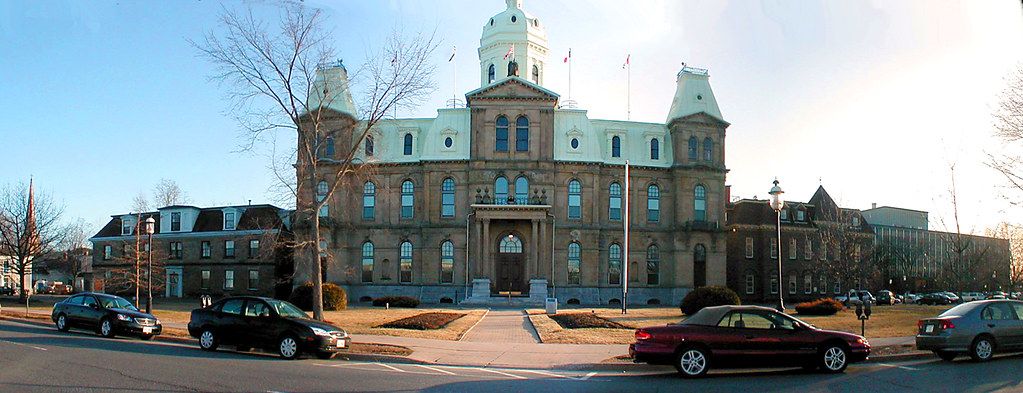
Stand on the Queen Street sidewalk at 706 and look up. The dome climbs past the elms in stacked stages, a glazed lantern perched on top and a figure of Britannia, trident in hand, standing guard above the entrance below it. This is the most architecturally ambitious thing anyone has ever built in Fredericton, and it was built by a province that had just watched its old capitol burn. It has been the working seat of New Brunswick democracy since 1882, which means it is not a museum. Laws are still argued into existence under that dome, and you can walk in off the street, for free, and watch.
The building also sits in a much older story. It faces the Wolastoq, the river colonial mapmakers relabelled the Saint John, in a stretch of the valley where Wolastoqiyik people lived, fished and gathered for thousands of years before Loyalist tents went up in 1783. Dumaresq’s stone carvers acknowledged that history in their own Victorian way: at the upper corners of the portico are carved faces wearing feather headdresses, an unusual gesture for a government building of the 1880s, sitting alongside a carved head of Queen Victoria over the main door. The layers of who this place belongs to are literally cut into the stone. For the deeper story of the valley before the province existed, see our guide to Wolastoqey Fredericton.
And it matters because of what it holds. Behind the chamber, in a library built like a small Roman basilica, sits one of the rarest books on Earth. In the chamber itself hang portraits with a fire-rescue legend attached. Underfoot and overhead is one of the finest surviving Victorian interiors in Atlantic Canada, brought back wallpaper roll by wallpaper roll in a meticulous 1988 restoration. Fredericton is a city of good buildings. This one is the flagship, and most locals have never been past the front step. This guide is your reason to fix that.
Three weeks in February 1880: the death of Province Hall
To understand the building you see, you need the building you can’t. Province Hall was the government’s first purpose-built home in Fredericton, a frame structure raised on this very site at the turn of the nineteenth century (the Canadian Parliamentary Review dates it to 1803). For nearly eight decades it housed the House of Assembly, the appointed Legislative Council and the Supreme Court all at once, and by the 1870s it was bursting at the seams and falling out of favour. One contemporary account, preserved in the Parliamentary Review, dismissed it as “a disgraceful looking and shabby, ill-ventilated shanty.” Hardly the language of a beloved landmark. The Dictionary of Canadian Biography dates the push for a replacement to the years 1878 through 1880, and on February 4, 1880 the government formally announced an architectural competition for a new capitol.
Three weeks later, fate co-signed the decision. On the night of February 25, 1880, fire tore through Province Hall, destroying the roof and upper floor and finishing the old building as a working seat of government. What started it depends on who you ask. The Fredericton Heritage Trust uses the word every historian loves and dreads, calling it a suspicious fire; the Canadian Parliamentary Review records a more domestic culprit, “a register grate too close to the carrying timbers.” No arsonist was ever named, and the overheated-grate explanation has the ring of a fire marshal’s shrug. Either way, eight decades of New Brunswick’s public life went up with the roof, and with it went any argument for delay.
What survived matters as much as what burned. The province’s legislative library collection, including the colossal Audubon folio it had owned since 1852, came through the era intact, and the full-length royal portraits that now preside over the Assembly Chamber are said on tours to have been carried from the flames. The documentary trail on that rescue is thinner than the storytelling, and we flag that honestly below. But the physical fact is undeniable: objects older than the fire hang and rest inside the new building today.
The fire turned a competition into a sprint. Within months a winner was chosen, a contractor signed, and stone was moving toward the capital. New Brunswick, a province never accused of spending freely, was about to put up the most extravagant building in its history.
A competition, an architect, and a point to prove
The winner was James Charles Philip Dumaresq, and he is worth knowing. Born December 18, 1840 in Sydney, Nova Scotia, into a family descended from Jersey gentry, educated at Horton Academy in Wolfville, he came up the hard way: the record shows him working as a carpenter in Sydney in the late 1860s, and no one has ever found evidence of formal architectural schooling. He likely apprenticed, as most Canadian architects of his generation did. He opened a Halifax practice in the early 1870s, landed a major commission with the replacement Acadia College building in 1877, and then did the shrewdest thing of his career: he followed the work to Saint John, where the Great Fire of June 1877 had levelled the commercial heart of the city and created the busiest construction market in the Maritimes. His Bank of Nova Scotia on Prince William Street (1877 to 1878) announced him. So when Fredericton needed a capitol, the man the sources call “J.C. Dumaresq of Saint John” was in exactly the right place with exactly the right portfolio.
His design was Second Empire, the French-flavoured style that swept official Canada in the 1870s and 1880s: mansard roofs, corner pavilions, a pedimented centre bay, and above it all a soaring domed cupola. It was the architecture of confidence, worn by post offices and parliament buildings across the young Dominion, and for a province rebuilding its dignity from a gutted shell it was precisely the message. Dumaresq packed the programme tight: an Assembly Chamber and a Legislative Council chamber, a Supreme Court chamber, and at the rear a library designed, wonderfully, in the form of a Roman basilica, complete with apse. His original drawings, inked on linen, are still preserved in the building.
Fredericton was the summit of his public work, but not the end of his story. He went on to the Forrest Building at Dalhousie (1887) and the main college building at Mount Allison in Sackville (1893), partnered for roughly a decade with Saint John architect Harry H. Mott, and brought his son Sydney Perry Dumaresq into the firm in 1899, founding a family practice that shaped Halifax for a century. He died in Halifax on December 20, 1906, two days past his sixty-sixth birthday, leaving New Brunswick his masterpiece.
The build: sandstone, granite and a $120,000 gamble
The construction tender drew 32 bids, ranging from $61,900 to $94,200, and the contract went to William Lawlor of Chatham, a Miramichi builder taking on the biggest job in the province. His accepted bid for the stone construction was $68,880, later adjusted to a final settlement of $72,085.75 as the realities of the site set in, and by the time the building was finished and furnished the province had spent roughly $120,000, a breathtaking sum for 1880s New Brunswick. Work commenced on May 17, 1880, with the fire barely cold, and the pace never slackened: the shell rose through 1881 and the finished capitol opened in the winter of 1882. Under two years, start to finish, for a domed stone parliament. Modern renovation projects should look away in shame.
The materials were proudly provincial. The walls are olive-brown sandstone from the famous quarries at Dorchester, the same stone that built half the landmark buildings of the Maritimes, trimmed with hard grey granite from Spoon Island in the Saint John River near Gagetown, floated downriver practically past the front door. At the entrance, tall tapered stone columns carry carved Corinthian capitals, the front door is solid walnut, seven feet wide and twelve feet high, and the sculptors ranged freely above: Victoria’s head over the doorway, the feathered faces at the portico corners, and Britannia presiding over the entrance below the dome.
What did $120,000 buy in 1882? For context, the contractor’s entire accepted bid was $68,880, and skilled tradesmen of the day earned a dollar or two per day. The furnished building cost the equivalent of several thousand man-years of labour, spent by a province of barely 320,000 people that had just lost its capitol. It remains one of the best returns on public money New Brunswick ever got.
On February 16, 1882, the new building opened with a crowd of some 2,000 people, and Lieutenant-Governor Robert Duncan Wilmot, a Father of Confederation whose political career had begun in the old Province Hall decades before, presided over the first session of the Legislature in its new home. It is a lovely closing of the circle: a man whose politics were forged in the burned building inaugurating its successor. The House has met there ever since.
The dome, the lantern, and a staircase with no visible means of support
The dome is Fredericton’s true landmark, more so than any steeple or office block. It rises as a tower through the roofline, carries a colonnaded drum, and finishes in a glazed lantern that glows at night. How tall is it? Here the sources politely disagree: Wikipedia gives about 41 metres (135 feet) to the top of the central rotunda, the Fredericton Heritage Trust says the cupola reaches 144 feet, and the Canadian Parliamentary Review splits the difference at 140 feet above ground level. The honest answer is that the figure depends on whether you stop measuring at the dome, the lantern or the finial, and nobody seems to have climbed up with a tape lately. What is certain is that it was, and remains, the tallest statement the province ever made about itself.
The dome you see today is also a survivor of quieter emergencies. By the early 2000s water had been working on it for twelve decades, and a major restoration begun in 2006 replaced deteriorated wooden framing and sheathing and stripped off the old galvanized steel cladding in favour of copper, which has since mellowed toward the green patina a proper capitol deserves. The provincial government marked the dome work nearing completion in November 2006. Preservation is not an event here; it is a permanent line item.
Inside the front doors, past a vestibule of commemorative plaques, you reach the moment every tour guide saves: an entrance hall hung with portraits, and rising through it, the famous spiral staircase. It is self-supporting: no central newel post, no visible props, just a helix of treads locked into the masonry and into each other, each step carrying its neighbours in a piece of nineteenth-century structural showmanship. Visitors have been standing at the bottom rail making the same disbelieving face since 1882. It is the building’s party trick, and 140-plus years on, it has never needed a net.
Look up from the stairwell and the geometry keeps going, ring above ring, toward the light of the lantern. It is the closest thing Fredericton has to a cathedral crossing outside the actual Cathedral, and it costs nothing to see.
The Assembly Chamber: a Victorian jewel box with a throne
The Assembly Chamber is the heart of the building and the best-preserved grand Victorian interior in the province. The room measures 55 feet by 43, and its ceiling soars a full 43 feet, carried on eight Corinthian columns supporting panelled arches, wrapped by a steep public gallery and lit by chandeliers of brass hung with Irish crystal that were converted from gas long ago but never lost their sparkle. The walls carry the dense, Japanese-influenced patterned wallpaper that high Victorian taste adored, and that is not an accident of survival: a 1988 refurbishment, built on serious historical research, rehung the room with more than 275 rolls of reproduction period wallpaper and some 457 metres of fabric for the draperies. The result is that the chamber looks more like 1882 today than it did in 1970.
At the head of the room the Speaker presides from a carved chair raised on a dais beneath a canopy bearing a carving of the Royal Coat of Arms, an ensemble so architectural that everyone, guides included, calls it the Speaker’s throne. It is the ceremonial centre of gravity of the province: every bill that becomes New Brunswick law passes, in effect, beneath that canopy.
Then there are the royal portraits, and here the historian in us owes you precision. The full-length portraits of King George III and Queen Charlotte associated with the chamber have long been attributed to Sir Joshua Reynolds, court painter of the age; art historians would gently note that grand royal portraits of this type were produced in numbers by studios and copyists, and a firm scholarly attribution for the Fredericton pair has never been published. The cherished story that they hung in old Province Hall and were carried out of the flames in February 1880 is repeated on tours and in guidebooks, and it is entirely plausible, since the paintings predate the fire and were in provincial hands. But the contemporary documentation is thin, and we would rather tell you that than invent a footnote. Believe the story; hold the attribution loosely.
The art on the walls is not frozen, either. In early 2026 the legislature moved rotunda portraits of two British colonial figures, the 1st Earl of Sheffield and Lord Glenelg, into storage, replacing them with composite photographs of recent MLAs, while portraits of past monarchs stayed in the chamber and committee rooms. A working parliament curates its past continuously. The chamber is a living room in the truest sense.
The Audubon in the back room: an £800 bet that became a treasure
Walk toward the rear of the building and you reach the Legislative Library, Dumaresq’s Roman basilica in miniature: a high timber ceiling with exposed beams, clerestory light, a curved south-facing apse window, and alcoves of butternut bookcases holding a general collection of roughly 40,000 volumes plus a couple hundred thousand government documents. Four iron doors guard its entrances, an 1880s fireproofing measure installed by people who had extremely fresh memories of why fireproofing matters. And in this room lives the single most valuable object owned by the people of New Brunswick.
In 1852, legislative librarian Robert Gowan spent £800 at Little, Brown in Boston on a complete set of John James Audubon’s Birds of America, the legendary double elephant folio: four immense volumes, 435 hand-coloured copper-plate engravings, each page roughly a metre tall, every bird rendered life-size. It was a staggering sum for a small colony to spend on a book, and one of the great bargains in Canadian collecting. Roughly 120 complete sets are known to survive worldwide, and complete folios have sold at auction in recent decades for between eight and twelve million dollars. Canada Post, issuing its final Audubon stamp set in 2005, called the Legislative Library’s folio one of only five publicly owned copies and drew stamp images from it. And the man himself knew this town: Audubon lodged at Government House in Fredericton in September 1832 during one of his northern expeditions, twenty years before the province bought his masterwork.
The best free exhibit in the city: a volume of the folio rests in a display case, opened to a single magnificent plate, and the page is periodically turned so the display slowly migrates through Audubon’s aviary. Ask about it when you visit; seeing a life-size bird engraved on copper in the 1830s and painted by hand is worth the trip alone.
The set has been cared for accordingly. Volume one underwent a full conservation treatment between 1976 and 1979 by Father Charles Brandt, the hermit-priest and renowned book conservator, who later wrote in detail about the folio’s paper, inks and restoration. And remember the timeline: the province bought this book 28 years before Province Hall burned. However it came through that era, it has now survived everything New Brunswick history has thrown at it. For more places guarding the city’s treasures, see our museums and heritage guide.
History made under this roof (and the ghosts it doesn’t have)
New Brunswick’s Assembly is older than the building by nearly a century. The first elected House met in January 1786 in Saint John, before the capital moved upriver to Thomas Carleton’s safely inland new town of Fredericton. The great constitutional fight of the nineteenth century, responsible government, the radical idea that the ministry must answer to the elected House rather than to the governor, was waged from Fredericton by reformers like Lemuel Allan Wilmot and Charles Fisher, and achieved in stages through the late 1840s and early 1850s, sealed when Fisher’s Reformers took office in 1854. Those battles played out in old Province Hall, but the 1882 chamber inherited the tradition whole, along with, fittingly, Lieutenant-Governor R.D. Wilmot presiding at its opening. The new building even outlived part of its own floor plan: the appointed Legislative Council was abolished in 1891, leaving New Brunswick with the single elected chamber it has today.
The current chamber has earned its own list of hinge moments. On April 17, 1919 women won the provincial franchise, though they could not stand for the Assembly until 1934, and the first woman was not elected to it until Brenda Robertson in 1967. Under Premier Louis Robichaud in the 1960s it passed the Programme of Equal Opportunity, the sweeping reform that equalized schooling, health and justice across rich and poor counties. And in 1969 it adopted the Official Languages Act that made New Brunswick Canada’s first, and still only, officially bilingual province. Simultaneous interpretation hums in the galleries to this day because of what happened in that room.
As for ghosts: Fredericton keeps a well-stocked spectral inventory, but the Legislature, perhaps disappointingly, has no well-documented resident phantom. No grey lady on the spiral staircase, no spectral Speaker. Its hauntings are of the archival kind: portraits whose provenance nobody wrote down, and a fire blamed on a grate by one source and called suspicious by another. If you want the city’s certified shivers, our haunted Fredericton guide has you covered; the Legislature’s mysteries prefer daylight.
Visiting today: free tours, real democracy, no ticket required
Here is the remarkable part: all of this is free. The Legislative Assembly offers guided tours, about 30 minutes long, Monday to Friday from 8:30 a.m. to 4:30 p.m. year-round, with morning tours starting between 8:30 and 11:30 and afternoon tours from noon to 4:00; in high summer (early July to the end of August) tours extend to Saturdays and Sundays. Arrive ten minutes early for security screening. The buildings are wheelchair accessible, and the tour office ((506) 453-2527) will arrange accommodations and group visits with advance notice. When the House is sitting, you can simply take a seat in the public gallery, headset available for simultaneous English-French interpretation, and watch your province govern itself beneath the crystal chandeliers. Gallery space is limited to about 100 seats for groups, so large parties may be split.
Give the whole block your attention while you are there. The Legislative Assembly complex was formally recognized as a Provincial Historic Site on June 6, 2000 under the Historic Sites Protection Act and listed on the Canadian Register of Historic Places on May 20, 2004, and it includes three buildings: Dumaresq’s 1882 capitol; the 1888 Departmental Building (the West Block, by architect R.C. Dunn, in rugged Romanesque Revival); and the modest Old Education Building on the east side, whose Neoclassical core dates to 1816 (with Second Empire additions of 1869), making it the oldest surviving public building in Fredericton. The formal lawns, walkways and semicircular drive are part of the designation too. That unassuming east block, incidentally, predates the fire, Confederation and photography.
Make an afternoon of it. The Beaverbrook Art Gallery faces the Legislature across Queen Street, Officers’ Square and the Historic Garrison District are a five-minute walk downriver (see the Officers’ Square comeback), and City Hall, with its own Victorian story, anchors the far end of the same street (our City Hall guide). Then finish where you started: on the sidewalk at 706 Queen, looking up at Britannia and the lantern, at the building a fire built. More of the city’s layered past lives in our heritage hub.
Key takeaways
- The province announced the design competition for a new capitol on February 4, 1880, three weeks before Province Hall burned on February 25, so the fire confirmed a decision already made rather than forcing it.
- The fire’s cause is genuinely disputed: the Fredericton Heritage Trust calls it suspicious, while the Canadian Parliamentary Review blames a register grate set too close to the carrying timbers.
- Contractor William Lawlor of Chatham won the job from a field of 32 bids with an accepted bid of $68,880, settled at $72,085.75, and the entire furnished building came in around $120,000 in 1880s dollars.
- The Legislative Library bought its complete Audubon Birds of America folio in 1852, when librarian Robert Gowan paid £800 at Little, Brown in Boston; comparable sets now fetch eight to twelve million dollars at auction, and Audubon himself stayed at Fredericton’s Government House in September 1832.
- The first session in the new building opened on February 16, 1882 before a crowd of about 2,000, presided over by Lieutenant-Governor Robert Duncan Wilmot, a Father of Confederation whose career began in old Province Hall.
- The 1988 restoration of the Assembly Chamber used more than 275 rolls of reproduction period wallpaper and about 457 metres of fabric, and a dome restoration begun in 2006 swapped galvanized steel cladding for the copper you see greening today.
- The little Old Education Building beside the Legislature has a core dating to 1816, making it the oldest surviving public building in Fredericton, older than the capitol, Confederation and photography.
Common questions
Is it free to visit the New Brunswick Legislature?
Yes. Guided tours are free, last about 30 minutes, and run Monday to Friday from 8:30 a.m. to 4:30 p.m. year-round, with weekend tours added from early July to the end of August. Arrive ten minutes early for security screening. The buildings are wheelchair accessible; call (506) 453-2527 to arrange group visits or accommodations.
Can you actually see the Audubon Birds of America folio?
Yes, in a limited and lovely way. A volume of the four-volume double elephant folio is kept in a display case in the Legislative Library area, opened to a single plate, and the page is periodically turned. Ask about it when you arrive; staff are used to Audubon pilgrims.
Are the portraits of George III and Queen Charlotte really by Joshua Reynolds?
The attribution is traditional rather than proven. The full-length royal portraits have long been credited to Reynolds, but grand portraits of this type were widely produced by studios and copyists, and no firm scholarly attribution for the Fredericton pair has been published. The tour-guide story that they were rescued from burning Province Hall in 1880 is plausible, since the paintings predate the fire, but the contemporary documentation is thin.
Who designed the building and when did it open?
James Charles Philip Dumaresq, a Maritime architect then practising in Saint John, won the design competition and delivered a Second Empire capitol built of Dorchester sandstone and Spoon Island granite. Construction began May 17, 1880, and the first legislative session in the new building opened on February 16, 1882 before some 2,000 spectators.
What happened to the old Province Hall?
The original legislative building, a frame structure on the same site that had housed the Assembly, the Legislative Council and the Supreme Court since the early 1800s, was gutted by fire on the night of February 25, 1880, losing its roof and upper floor. The Fredericton Heritage Trust describes the blaze as suspicious, while the Canadian Parliamentary Review attributes it to a register grate too close to the carrying timbers. The library collection, including the Audubon folio, survived the era intact.
Can anyone watch the Legislature in session?
Yes. When the House is sitting, the public gallery above the Assembly Chamber is open, with simultaneous English-French interpretation available through gallery headsets. It is one of the few places in Canada where you can watch a bilingual legislature debate beneath 1880s crystal chandeliers, for free.

Get the Hey Freddy week ahead, every Monday
Fredericton’s events for the week, in one short email. Free, unsubscribe anytime.
Sources & further reading
This guide reflects the documented local consensus, reporting, reviews and community voices, verified where possible. Things change; if we’re out of date, tell Freddy.
- Canadian Register of Historic Places: Legislative Assembly Block, Fredericton
- Canadian Parliamentary Review: The New Brunswick Legislative Building
- Fredericton Heritage Trust: Legislative Assembly Building
- Legislative Assembly of New Brunswick: Visit the Legislature
- Dictionary of Canadian Biography: James Charles Philip Dumaresq
- Canada Post news release (2005): Audubon’s Last Stand, final set of stamps
- Canadian Parliamentary Review: New Brunswick’s Legislative Assembly (Desserud and Hyson)
- CBC News: Audubon’s Birds of America, a rare sighting at New Brunswick’s Legislative Library
- CBC News: Earl exits, lord leaves: N.B. legislature removes colonial portraits
- My New Brunswick: New Brunswick Legislature
- My New Brunswick: Legislative Library
- My New Brunswick: New Brunswick Legislature Dome
- Wikipedia: New Brunswick Legislative Building
- Father Charles Brandt: Conserving Audubon’s Birds of America, Volume 1