 ™
™
Guides · 🏙️ City life
The Old Arts Building: Two Centuries of Classes, Stargazing and Close Calls on UNB’s Hill
Halfway up Fredericton’s hill stands Sir Howard Douglas Hall, the Old Arts Building, begun in 1826 and formally opened on 1 January 1829. Parks Canada designated it a national historic site in 1951 as the oldest university building in use in Canada. Designed by barrack-master John Elliott Woolford for a £25 prize, it housed all of King’s College under one roof, watched Canada’s first astronomical observatory rise beside it in 1851, and still runs UNB’s administration today. This is its whole story: fires dodged, near-closures survived, and the professor in a wooden tower next door who corrected the map of the province.
Why a stone hall on a hill matters this much
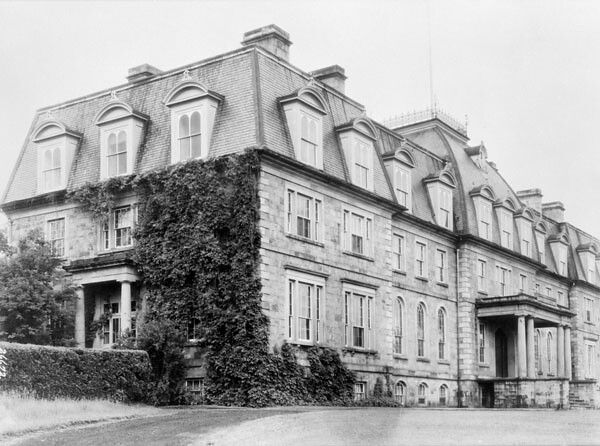
Climb the walkway from University Avenue to the top of UNB’s old quadrangle and turn around. Below you, the roofs of Fredericton run down to the river, the spire of Christ Church Cathedral pokes through the trees, and the whole city arranges itself the way it has for two hundred years. At your back stands a long, grey, three-storey stone building with a columned portico and a mansard roof: the Old Arts Building, known officially since 1999 as Sir Howard Douglas Hall. It does not shout. It has never needed to.
Here is what that quiet building holds. Parks Canada designated it a national historic site on 30 May 1951 for one crisp reason, stated in the designation record in nine words: it is “the oldest university building in use in Canada.” Not the oldest preserved, not the oldest reconstructed. The oldest still doing its job. The college first occupied it in 1828, Sir Howard Douglas formally opened it on 1 January 1829, and on any weekday morning in 2026 the lights still come on, because the building now houses the university’s administration, including the office of the president. You will see other dates floating around: UNB’s own archives mention a 1953 recognition and a plaque event on 9 June 1993. Those are commemorations. The federal designation record is clear, and where sources differ this guide follows the designation documents.
The building also anchors a bigger claim. UNB describes itself, carefully and correctly, as the oldest English-language university in Canada, a lineage that starts with a Loyalist petition in 1785. Université Laval’s roots run older but francophone; Halifax’s King’s College traces to 1789. The precise wording matters, and we will unpack it below. What no one disputes is this: if you want to touch the physical beginnings of English-language higher education in this country, you come to this hill, to this hall.
Before the college: a hill above the Wolastoq
Long before anyone spoke of colleges, the hill belonged to the landscape of the Wolastoqiyik, whose name for the river below, the Wolastoq, means the beautiful and bountiful river. The slope where the quad now sits looks out over a stretch of water that has carried people, canoes and trade for thousands of years, and UNB itself acknowledges that its campuses stand on unceded Wolastoqey territory. That deeper story of this place is told in our guide to Wolastoqey Fredericton, and it is worth holding in mind as you read everything that follows.
The paper trail of the university begins on 13 December 1785, barely two years after the Loyalist landings, when petitioners including Ward Chipman and the Harvard-educated William Paine put a memorial before Governor Thomas Carleton urging early attention to “the establishment … of an academy of liberal arts and sciences” in the brand-new capital. The government moved with startling speed: the executive council ordered the attorney general to draft a charter that very day, modelled on the charter of King’s College in New York, and roughly 6,000 acres near Fredericton were set aside to support the school. The resulting Provincial Academy of Arts and Sciences taught its first pupils in a cottage on what is now University Avenue before getting a building of its own by 1793. It was a school more than a university, but it planted the flag.
On 12 February 1800 the academy received a provincial charter and became the College of New Brunswick, with the Reverend James Bisset as its first principal. This is the load-bearing date in the famous claim. UNB’s exact formulation is that it is “the oldest English-language university in Canada,” counting from the 1785 founding and the 1800 charter. Rival genealogies exist: Laval traces itself to the Séminaire de Québec of 1663, francophone and older, while King’s College in Nova Scotia dates its founding to 1789 and its royal charter to 1802, and honest historians enjoy arguing the fine print over a pint. The defensible version, the one UNB itself uses, rests on 1785 and 1800, and the building on the hill is where that paper lineage finally became stone.
Sir Howard Douglas, the governor who willed it into being
The College of New Brunswick spent its first quarter-century as a modest downtown operation, more grammar school than college. What changed everything was the arrival of Sir Howard Douglas, who landed in New Brunswick on 28 August 1824 to take up the lieutenant-governorship. Douglas was a career soldier, a Peninsular War veteran who had helped direct the desperate embarkation of British troops at Corunna in 1809, and the author of a standard 1820 treatise on naval gunnery. He attacked civilian administration with the same energy. When the catastrophic Miramichi Fire tore through the northeast of the province in the fall of 1825, Douglas organized relief on every front, dispatching an agent to Quebec for supplies, opening public subscriptions and touring the burned-out settlements, and during that same terrible fire season he personally directed the firefighting in Fredericton itself, where some eighty houses and stores were destroyed. A newspaper of the day called him “our active and indefatigable Governor.” He was, by the standards of colonial governors, a doer.
Douglas decided the little college should become a real one, with a royal charter, a proper endowment and a building worthy of the ambition. He lobbied London hard, hoping for an institution open to all regardless of creed. What he got, in 1828, was a royal charter creating King’s College, Fredericton, with full university powers, more stubbornly Anglican in character than he had wanted, and with Douglas himself as first chancellor. He took the win and kept building.
He had not waited for the paperwork. Ground was broken on the hill in 1826, and on 11 September 1826 the cornerstone went down, an occasion long credited to Douglas personally. On 1 January 1829 he presented the royal charter and presided over the formal opening of the completed building, declaring, in words UNB still quotes, “Firm may this institution ever stand and flourish.” Within the year he was gone, sailing for England to argue New Brunswick’s case in the simmering Maine boundary dispute, and he formally resigned the governorship in February 1831. Fredericton did not forget him. In 1949 the university unveiled a memorial window in his honour, and in October 1999 it renamed the whole building Sir Howard Douglas Hall, a late-1990s gesture we note in our look back at Fredericton in the 1990s.
The build: a barrack-master’s £25 masterpiece
In 1825 the college held a design competition, and the winner was John Elliott Woolford, Fredericton’s barrack-master, a former landscape artist who had travelled and worked under the patronage of Lord Dalhousie before settling into military administration in New Brunswick. His prize was £25. Woolford was no one-hit wonder: he also designed Old Government House down on Woodstock Road, begun in 1826, which means one part-time architect gave Fredericton two of its most important buildings almost simultaneously.
Woolford’s design was classical, in the Palladian manner: a symmetrical stone block with projecting end pavilions, ordered rows of windows and a columned central portico. His original drawings were grander than what got built. The planned dome, balustrade and clock were dropped during construction in favour of a simpler, cheaper pediment, an early and very Fredericton lesson in trimming the estimate. Even trimmed, the masonry building that rose on the hillside was among the most substantial structures in the colony.
The dates deserve a moment, because you will see this building tagged 1825, 1826, 1827, 1828 and 1829 in different books, and every one of those years is defensible. The design was chosen in 1825. Sod was turned and the cornerstone laid in 1826. Parks Canada dates the main construction 1826 to 1827. The college first occupied the building in 1828, which is the year on the federal plaque, and the formal opening came on 1 January 1829. The honest formulation historians use is built 1825-29, and now you know exactly what each year in that range means.
Inside, Woolford packed an entire institution into one envelope. The main floor held the chapel, the dining room, the library, classroom space and apartments for the professors. Students lived on the floor above. Below stairs were the kitchen, laundry and servants’ quarters. For decades this single building was, in every sense, the whole college.
Life under one roof: parsons, poets and carved initials
The man who ran the place for its first three decades was Edwin Jacob, an Oxford-trained Anglican clergyman who served as vice-president and principal from the opening in 1829 until his retirement in 1859, thirty years almost to the day. Jacob kept the curriculum stubbornly classical, heavy on Greek, Latin and divinity, in a timber-and-farms colony that increasingly wanted surveyors and engineers. He was learned, devout and, by many accounts, immovable, and both his dedication and his stubbornness shaped everything that happened in these rooms. The chapel where he preached still exists just left of the front door, dedicated in his memory on 15 May 1963 as the Edwin Jacob Memorial Chapel.
Daily life was intimate to the point of claustrophobia. Enrolment in the King’s College years was often a few dozen young men, who slept upstairs, ate in the dining hall, prayed in the chapel and recited their lessons all without stepping outside, which mattered in a Fredericton February. The wooden benches in the chapel carry more than a century of carved initials, names and dates, an unauthorized guest book that the university wisely never sanded away.
Through these rooms passed a remarkable share of nineteenth-century Canadian culture. Charles G.D. Roberts, later called the father of Canadian poetry, took his degree in 1879; his cousin Bliss Carman followed in 1881. Both appear in our roundup of famous people from Fredericton. And in 1885 the university opened its doors to women, with Mary K. Tibbits earning her degree in 1889 as UNB’s first woman graduate, a small revolution that unfolded partly in these same classrooms.
Brydone Jack and the little observatory that measured the province
In September 1840 King’s College recruited a 22-year-old Scot named William Brydone Jack, fresh from his MA at St Andrews, as professor of mathematics and natural philosophy. He intended a short stay. He remained 45 years, and he is the closest thing this story has to a genius in residence. Jack looked at a college teaching Latin verbs to a handful of gentlemen’s sons and decided what it really needed was a world-class telescope.
Astonishingly, he got it. In March 1847 the college council set aside £550 sterling for scientific instruments, with £300 earmarked for “a good seven feet achromatic telescope.” The instrument that answered the call, a refractor of mahogany and brass by Merz & Sons of Munich, successors to the great Fraunhofer, arrived in New Brunswick in May 1849 at a final cost of just over £504. The wooden observatory built to house it, an octagonal tower about fourteen feet across with two twelve-foot wings and a rotating, copper-sheathed roof that a single person could turn, was reported complete to the college council on 19 March 1851 at a cost of £170 9s 7d. It stands to this day at the east entrance of Sir Howard Douglas Hall, and it is recognized as Canada’s first astronomical observatory, itself designated a national historic site in 1954.
The night Fredericton learned where it was: in 1855, working with Dr J.B. Toldervy, Brydone Jack exchanged telegraph signals with the Harvard College Observatory and fixed Fredericton’s longitude at 4 hours, 26 minutes, 33.43 seconds west of Greenwich. He went on to fix positions for nearly forty New Brunswick communities, and in 1856 his telegraph measurements at Grand Falls and Little Falls exposed errors in the British commissioners’ boundary survey along the Maine line, vindicating the American figures of 1842. A professor in a wooden tower on this hill literally corrected the map of the province.
Jack’s practical streak reshaped the college itself. Convinced that a colony of rivers and railways needed builders, he pushed engineering into the curriculum, and the first university lecture on civil engineering in Canada was delivered in this building on 15 February 1854, a milestone the Canadian Society for Civil Engineering marks with a plaque. When the reorganized university needed a president in 1861, Jack took the chair and held it until his retirement in 1885. He died on 23 November 1886, his sixty-ninth birthday, in the city he had fixed to the map. His story continues in our famous Frederictonians guide.
Near-death and reinvention: how the building refused to become a ruin
The building’s gravest danger was never flame. It was irrelevance. By the 1850s King’s College was in real trouble: enrolment had dwindled, the province resented funding what many saw as an Anglican finishing school, and there were serious public calls to shut the college or convert it to something more useful. Commissions investigated, newspapers editorialized, and for a while it was a live question whether the hill would keep its college at all. The rescue came through reinvention. In 1859 the legislature passed the act that stripped away the Anglican character of King’s College, and in 1860 the institution was reorganized under an amended charter with a new name, the University of New Brunswick, open at last to students of every denomination.
Fire, the other great killer of early Canadian institutions, somehow never got its chance. University College in Toronto burned in 1890; King’s College in Windsor, Nova Scotia burned in 1920; Fredericton’s own downtown was devastated by fire in 1850. The Old Arts Building dodged them all, which is precisely why the oldest-in-use title landed here. The university has not left this to luck: a 1952 renovation added a steel fire escape along with new ceilings on the top floor, heating repairs and a new roof, quietly armouring the old hall against the fate of its peers.
Meanwhile the building kept changing shape to stay useful. In 1876-77 Woolford’s shallow hip roof gave way to the current mansard, creating a full third storey for a growing university. A 1926 remodelling squeezed in still more enrolment. As the campus grew around it, the building handed off its roles one by one, residence, library, classrooms, and settled into its present life as the administrative heart of UNB, with the president working where undergraduates once slept.
The cornerstone came back up: in 1978, ahead of the building’s sesquicentennial celebrations, crews excavated the original cornerstone laid on 11 September 1826. Rather than rebury it, the university put it on display with the Great Hall’s permanent historical exhibit, and on 17 May 1979 laid a new cornerstone containing a time capsule. Few buildings anywhere let you stand eye to eye with their literal first stone.
The final act of reinvention was a name. For generations everyone simply said the Old Arts Building. On 23 October 1999, at the urging of former president Colin B. Mackay, the university formally dedicated it as Sir Howard Douglas Hall, returning the founder’s name to the front of the story 170 years after he opened the doors.
What to see today: the Great Hall, the chapel and the quad
Start outside. The building fronts onto UNB’s historic quadrangle, a sloping green framed by nineteenth and early twentieth-century halls, and generations of visitors have called it one of the loveliest old campus quads in the country. Walk to the front of the Old Arts Building and look down the hill: the view over the city to the river is essentially the panorama Douglas admired in 1829, with more trees and fewer woodpiles. Note Woolford’s composition while you are there, the projecting end pavilions, the even rhythm of the windows, the columned portico, and the 1876 mansard sitting on top like a Victorian hat on a Georgian head.
Inside, the Great Hall functions as a small museum of the university. Portraits of past presidents line the walls, and a permanent display traces the institution from the 1785 petition onward, with the excavated 1826 cornerstone among its treasures. Two memorial stained glass windows anchor the space, one unveiled in 1949 in honour of Sir Howard Douglas, the other in 1956, commemorating the university’s eighteenth-century origins.
Just left of the entrance is the Edwin Jacob Memorial Chapel, the building’s most atmospheric room. The benches are scarred with carved initials and dates going back more than a century, and the stained glass is by Molly Lamb Bobak, the celebrated painter (and Canada’s first official female war artist) who made Fredericton her home. Outside the east entrance stands the little white octagonal Brydone Jack Observatory of 1851, Canada’s first, now a modest museum space that opens only occasionally. For more heritage stops across town, see our guide to Fredericton’s museums and heritage places.
Visiting the hill respectfully (and a word about ghosts)
Sir Howard Douglas Hall sits at 3 Bailey Drive on the UNB Fredericton campus, an easy but genuinely steep fifteen-minute walk up the hill from downtown. The grounds and the quad are open to wander at any hour, and they are gorgeous on foot in every season. The building itself is a working administrative office, generally accessible during weekday business hours when the university is open; the Great Hall display and the chapel area are the parts a visitor can reasonably see. Campus parking is regulated on weekdays, so walking up, or visiting on a weekend for the exterior and quad, is the low-stress play. If your visit matters, check with UNB in advance, since hours flex with the academic calendar.
Respect is simple here. This is not a staged historic site with costumed interpreters; it is the head office of a living university that happens to be two centuries old. Keep voices down in the corridors, stay out of office areas, and be aware that each May the campus fills for Encaenia, UNB’s graduation season, when the old hall does exactly what it was built for and does not need tourists underfoot.
As for ghosts: Fredericton has a rich and well-documented spectral canon, but the Old Arts Building is, honestly, a quiet corner of it. No widely recorded haunting attaches to the hall itself, which after two hundred years of residents, divinity students and administrators is almost suspicious. If you want the city’s certified shivers, our haunted Fredericton guide has you covered, and the rest of the city’s built story lives in our heritage hub. The Old Arts Building offers something rarer than a ghost: an unbroken thread. Every person who has climbed that portico since 1829 was part of the same continuous enterprise, and when you climb it, so are you.
Key takeaways
- Architect John Elliott Woolford, Fredericton’s barrack-master, won the 1825 design competition with a £25 prize, and his planned dome, balustrade and clock were cut during construction in favour of a plain pediment.
- The original cornerstone, laid on 11 September 1826, was dug back up in 1978 ahead of the sesquicentennial and put on display, with a replacement time capsule cornerstone laid on 17 May 1979.
- Parks Canada designated the building a national historic site on 30 May 1951 as the oldest university building in use in Canada, but it only received the name Sir Howard Douglas Hall on 23 October 1999.
- The little white observatory beside the east entrance was Canada’s first astronomical observatory, finished in March 1851 for £170 9s 7d, while its Munich-made Merz telescope cost just over £504 against a £550 instrument budget.
- In 1855 William Brydone Jack used telegraph signals exchanged with Harvard to fix Fredericton’s longitude at 4 hours, 26 minutes, 33.43 seconds west of Greenwich, then positioned nearly forty New Brunswick communities.
- The first university lecture on civil engineering in Canada was delivered inside this building on 15 February 1854, a milestone marked by a Canadian Society for Civil Engineering plaque.
- The chapel benches carry over a century of carved student initials, and the chapel’s stained glass is by painter Molly Lamb Bobak, Canada’s first official female war artist.
Common questions
Is the Old Arts Building really the oldest university building in Canada?
Yes, with precise wording: Parks Canada designated it a national historic site on 30 May 1951 because it is the oldest university building in Canada still in use. Construction ran 1826-27, the college occupied it in 1828, Sir Howard Douglas formally opened it on 1 January 1829, and it has served its university continuously ever since, today as UNB’s administrative centre.
Is UNB the oldest university in Canada?
UNB’s careful claim is that it is the oldest English-language university in Canada, tracing to the 13 December 1785 petition for a provincial academy and the 12 February 1800 charter of the College of New Brunswick. Université Laval’s francophone roots reach back further, and King’s College in Nova Scotia (founded 1789, royal charter 1802) presses a rival claim, which is why the exact wording matters.
When exactly was the Old Arts Building built: 1825, 1826 or 1829?
All of the above, honestly. The design was chosen by competition in 1825, sod was turned and the cornerstone laid on 11 September 1826, Parks Canada dates the main construction 1826-27, the college first occupied it in 1828, and the formal opening came on 1 January 1829. Historians often simply write 1825-29.
Can I go inside Sir Howard Douglas Hall?
Generally yes, during weekday business hours when the university is open, since it is a working administrative building at 3 Bailey Drive. Visitors can see the Great Hall’s historical display, presidential portraits, memorial windows and the Edwin Jacob Memorial Chapel. The quad and exterior are open anytime, and they offer the best free viewpoint in the city.
Who was Sir Howard Douglas?
A Peninsular War soldier and author of an 1820 treatise on naval gunnery who arrived as lieutenant-governor of New Brunswick in August 1824. He led relief efforts after the 1825 Miramichi Fire, secured the 1828 royal charter that created King’s College, served as its first chancellor, is credited with laying the building’s cornerstone in 1826, and presided at its opening on 1 January 1829. He left for England later that year and resigned in 1831; the building took his name in 1999.
What is the small white building beside the hall?
The William Brydone Jack Observatory, completed in March 1851 and recognized as Canada’s first astronomical observatory, itself a national historic site (designated 1954). Professor William Brydone Jack used its Merz & Sons refractor and telegraph signals exchanged with Harvard to fix Fredericton’s exact longitude in 1855. It now serves as a small, occasionally open museum.

Get the Hey Freddy week ahead, every Monday
Fredericton’s events for the week, in one short email. Free, unsubscribe anytime.
Sources & further reading
This guide reflects the documented local consensus, reporting, reviews and community voices, verified where possible. Things change; if we’re out of date, tell Freddy.
- Arts Building National Historic Site of Canada, Canadian Register of Historic Places
- Parks Canada Directory of Federal Heritage Designations: Arts Building NHSC
- UNB Libraries Archives: Old Arts Building
- UNB Libraries Archives: Brief History of UNB
- UNB Libraries Archives: The Early Days of the First Astronomical Observatory in Canada
- UNB Undergraduate Calendar: Fredericton Historic Buildings
- Fredericton Heritage Trust: Sir Howard Douglas Hall
- William Brydone Jack Observatory, Canadian Register of Historic Places
- Canadian Geographic: Here comes the sun, Canada’s first astronomical observatory
- Dictionary of Canadian Biography: William Brydone Jack
- Dictionary of Canadian Biography: Sir Howard Douglas
- CSCE Historic Site: King’s College (University of New Brunswick)
- UNB Quick Facts (oldest English-language university claim)
- MyNewBrunswick: UNB Old Arts Building